
US9820134B2 Claim 1 vs 3GPP TS 23.303: Sample Claim Chart
The content of a report SEPPi generated, shown as delivered. Reports are written in English.
Bibliographic data
- Patent number
- US9820134B2
- Title
- Proximity discovery, authentication and link establishment between mobile devices in 3GPP LTE
- Inventors
- Frank Fransen, Peter Veugen, Sander De Kievit, Maarten Everts
- Priority date
- 2013-01-25
- Filing date
- 2014-01-23
- Assignee
- Nederlandse Organisatie voor Toegepast Natuurwetenschappelijk Onderzoek TNO; Koninklijke KPN NV
- Standard assessed
- 3GPP TS 23.303 and TS 24.334 — restricted ProSe direct discovery, Model B — Any 3GPP Rel-13 ProSe-capable UE (Discoverer UE and Discoveree UE)
- Target release
- Rel-13 (TS 23.303 v13.6.0, TS 24.334 v13.7.0)
Claim 1 (independent)
A method for proximity discovery between a source device and one or more target devices, the method comprising: receiving in the source device a first data comprising an identifier, wherein the identifier is a temporary broadcast identifier uniquely identifying the one or more target devices and wherein the identifier is associable with the source device by the one or more target devices; receiving in the one or more target devices a second data comprising a first representation of the identifier; broadcasting by the source device a signal comprising a second representation of the identifier; receiving in the one or more target devices the signal; and comparing in the one or more target devices the first representation of the identifier with the second representation of the identifier to obtain a comparison result for establishing a successful proximity discovery.
Standard under assessment
Rel-13 · TS 23.303 v13.6.0 · TS 24.334 v13.7.0
Primary target: 3GPP TS 23.303 (Proximity-based services (ProSe); Stage 2) and TS 24.334 (ProSe UE to ProSe Function protocol aspects; Stage 3), restricted ProSe direct discovery, Model B, assessed at Rel-13 (TS 23.303 v13.6.0 and TS 24.334 v13.7.0, the last version of each in that release). In this procedure the Discoverer UE obtains a ProSe Query Code from the ProSe Function and announces it on PC5, while the Discoveree UE obtains a Discovery Query Filter built from that code and applies it to the messages it receives.
Release. The Model B clauses (TS 23.303 §5.3.2A, §5.3.3A.2, §5.3.3A.4 and §4.6.4.4; TS 24.334 §6.2.3B and §12.2.2.43) are absent from the last Rel-12 versions of both specifications and present in Rel-13, so Rel-13 is the release in which the claimed technology enters the standard. The cited wording is unchanged in Rel-19 except in TS 23.303 §3.1 and §5.3.3A.4 and in TS 24.334 §6.2.3B.2.
Branch charted. The Discoverer UE is the source device and the Discoveree UE the target device. The announce-and-monitor flows of Model A (open discovery, and restricted discovery) announce a code that belongs to the announcing UE itself, so the identifier of the claim, which identifies the target devices, is not found there. TS 23.304 (5G ProSe, named in the ETSI declaration) first appears in Rel-17, after the LTE ProSe specification charted here, and is not used.
Claim chart
Matching colors mark corresponding elements between the claim and the standard. An underline in a screenshot marks the text the mapping rests on.
A method for proximity discovery between a source device and one or more target devices, the method comprising:
Context: the claimed discovery is restricted ProSe Direct Discovery (Model B) between a Discoverer UE and a Discoveree UE, both served by E-UTRAN.

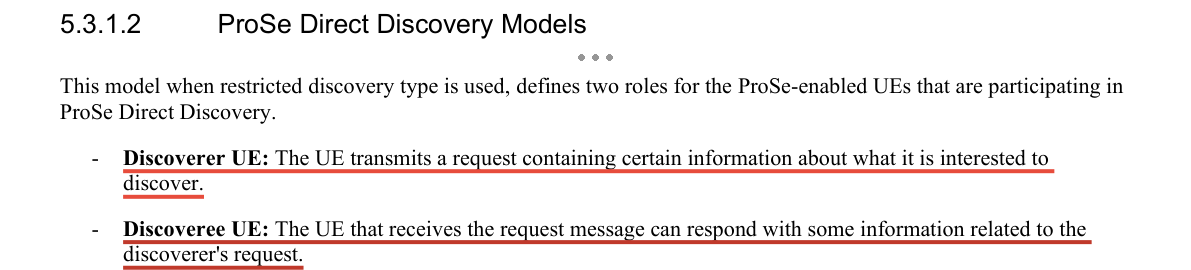
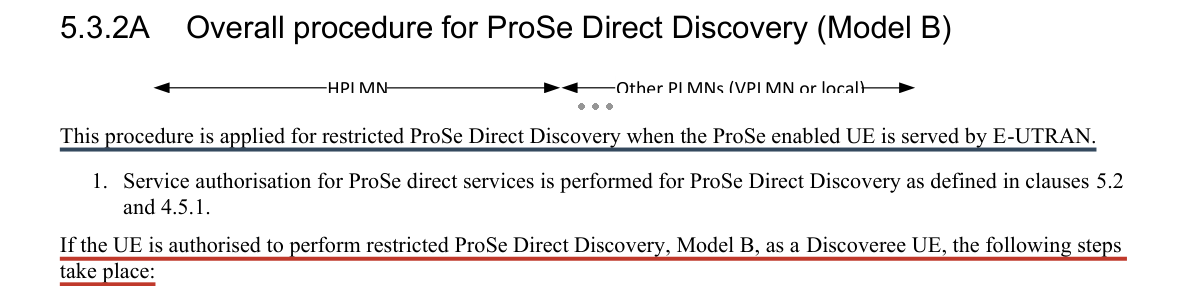
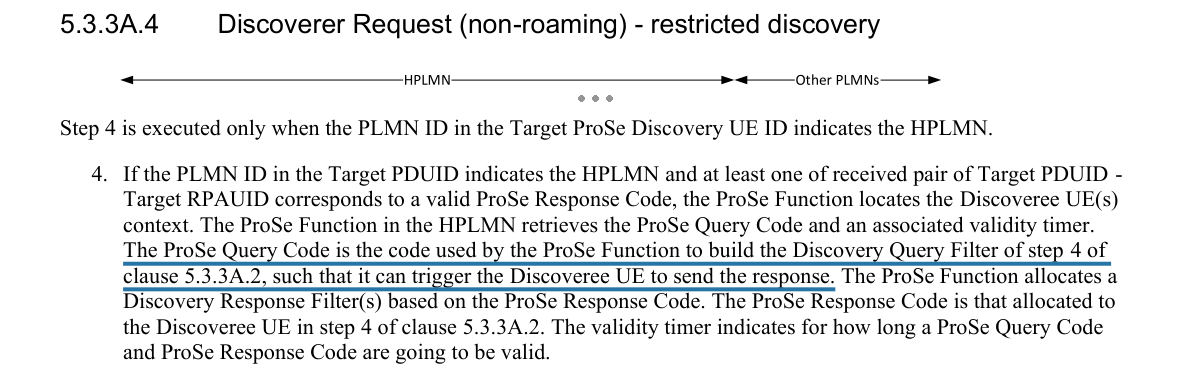
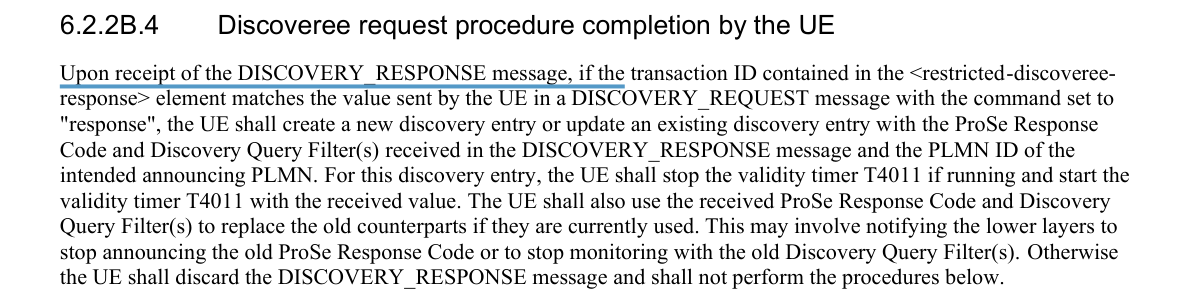
receiving in the source device a first data comprising an identifier,
The Discoverer UE initiates the discoverer request procedure and, on receipt of the DISCOVERY_RESPONSE message, takes the restricted-discoverer-response element in which the ProSe Function sends it the ProSe Query Code, obtained from its HPLMN ProSe Function.


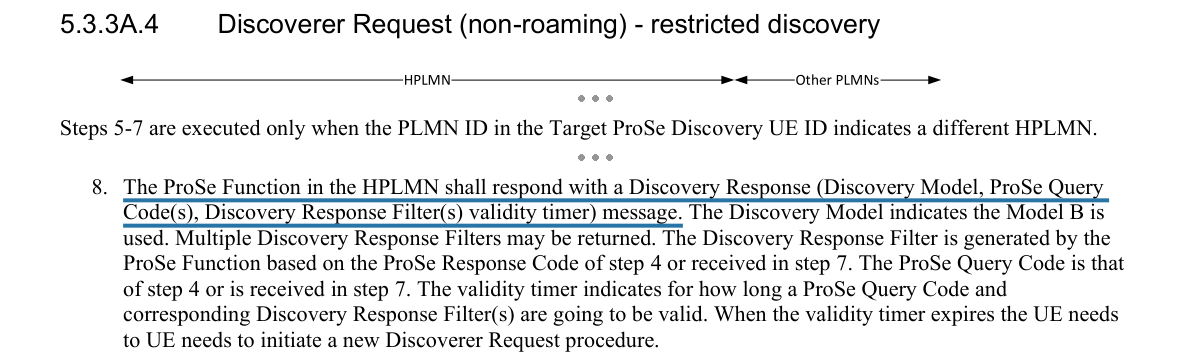

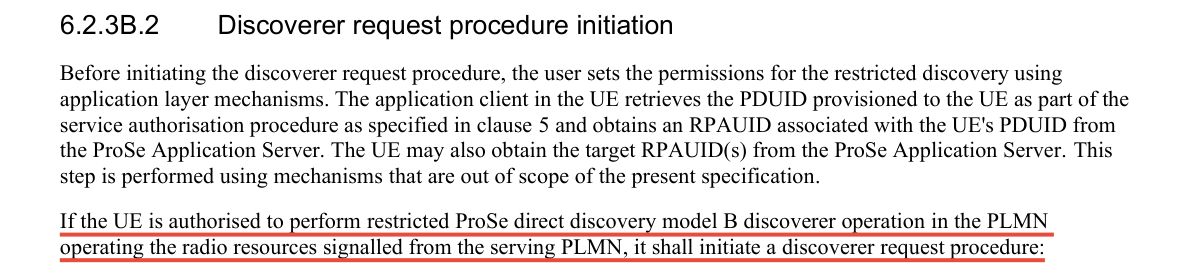


wherein the identifier is a temporary broadcast identifier uniquely identifying the one or more target devices and
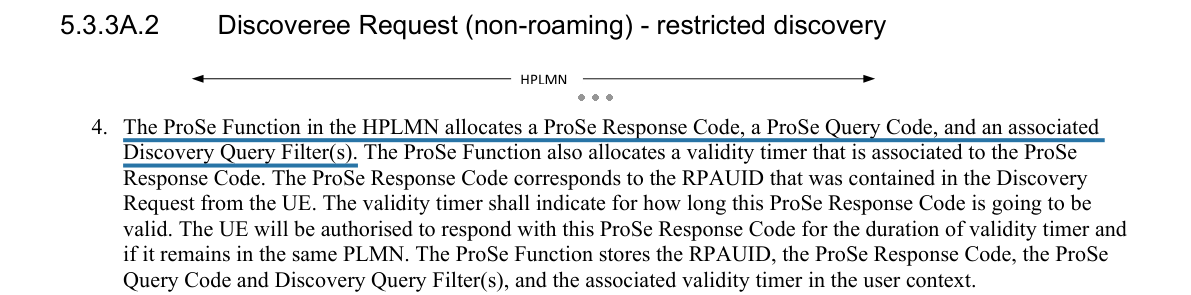
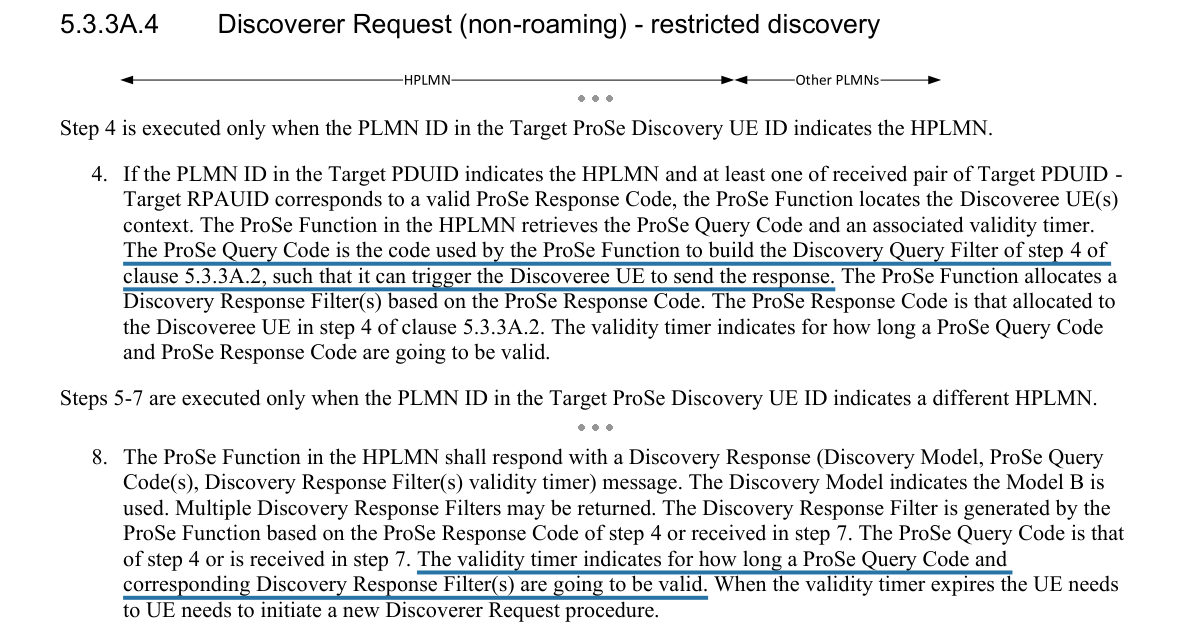
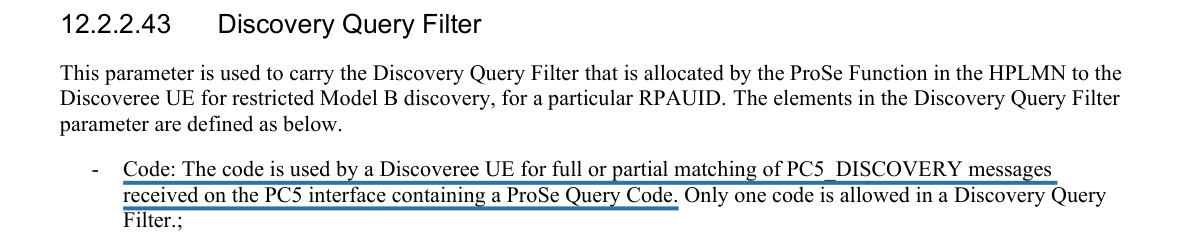
The ProSe Query Code is allocated together with the Discovery Query Filter of the Discoveree UE and stored in that UE's own user context, it is valid only for the period of its validity timer, and the Discoverer UE sends it over the air. The standard does not use the word "unique"; the code is read as unique to the Discoveree it is allocated for (narrow reading).


wherein the identifier is associable with the source device by the one or more target devices;
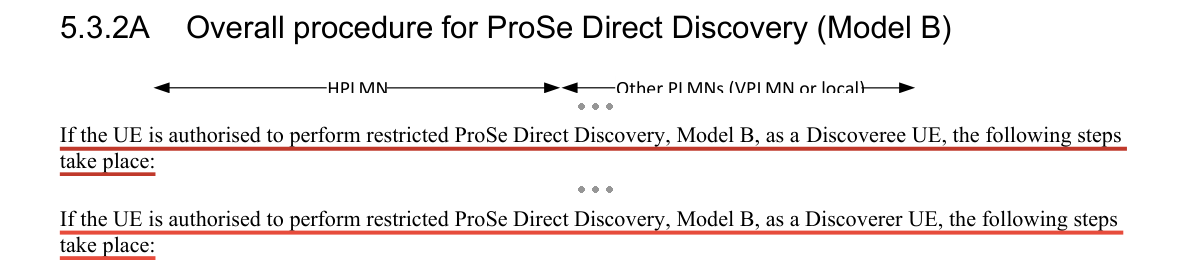
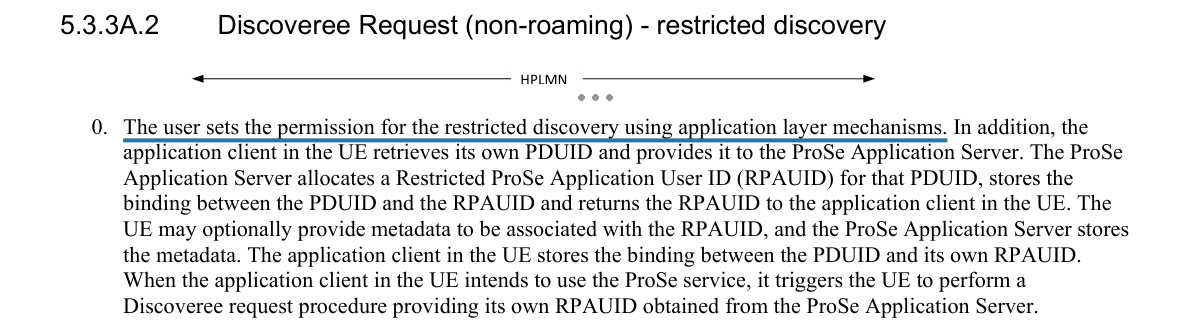
The user of the Discoveree UE sets the permission for the restricted discovery, and under that permission setting a Discoverer UE is authorised before the ProSe Function retrieves the ProSe Query Code (TS 23.303 §5.3.3A.4 steps 3.b and 4). The standard states this permission path, not the association itself, and it applies when that permission is set.
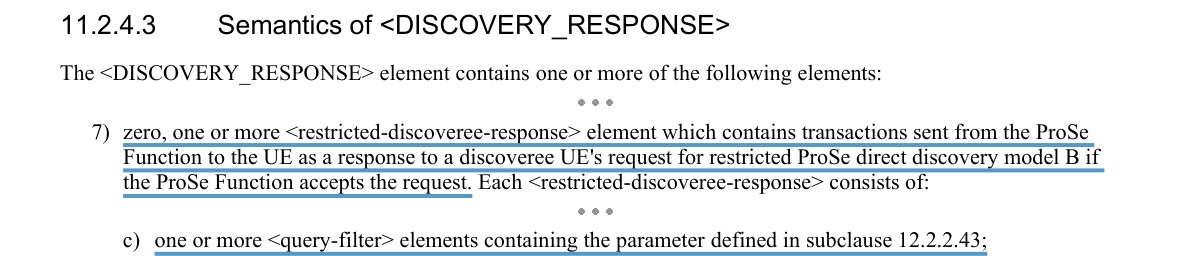
receiving in the one or more target devices a second data comprising a first representation of the identifier;
The Discoveree UE receives the restricted-discoveree-response element of the DISCOVERY_RESPONSE message, which carries the Discovery Query Filter built from the ProSe Query Code.


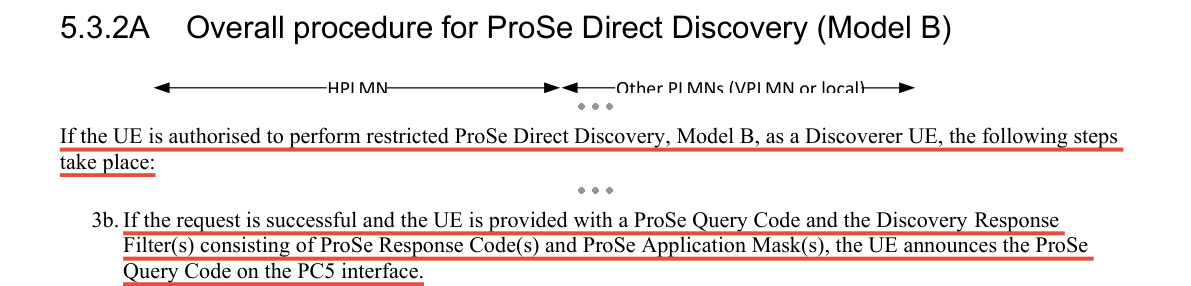
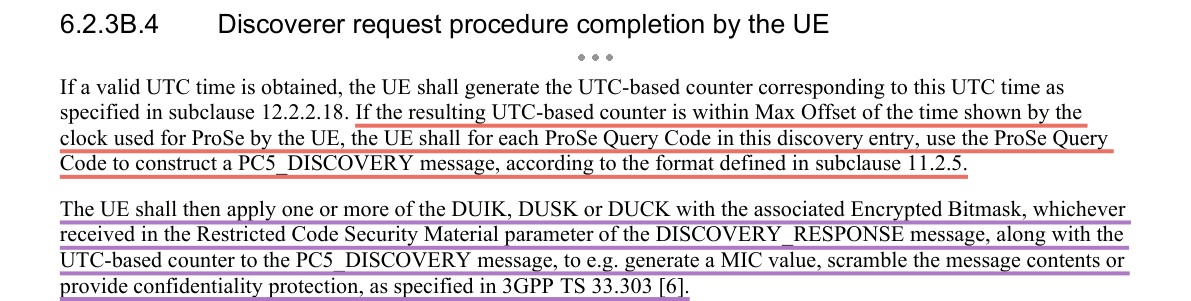
broadcasting by the source device a signal comprising a second representation of the identifier;
The Discoverer UE builds the PC5_DISCOVERY message from the ProSe Query Code, scrambles and protects the message contents with the DUSK, DUIK or DUCK, and announces it on the PC5 interface. The standard words this "announces" and names no addressee; it is read as broadcasting.


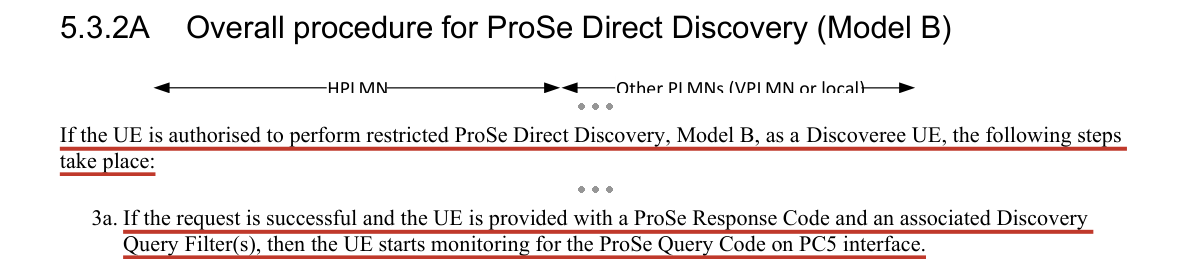
receiving in the one or more target devices the signal; and
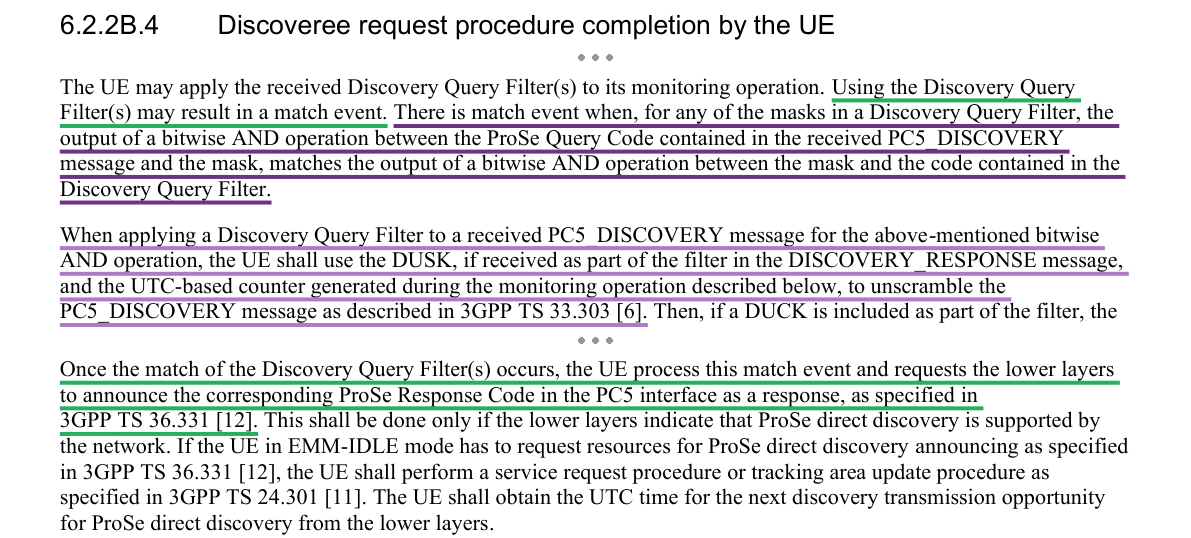
The Discoveree UE starts monitoring the PC5 interface for the ProSe Query Code and receives the PC5_DISCOVERY message.
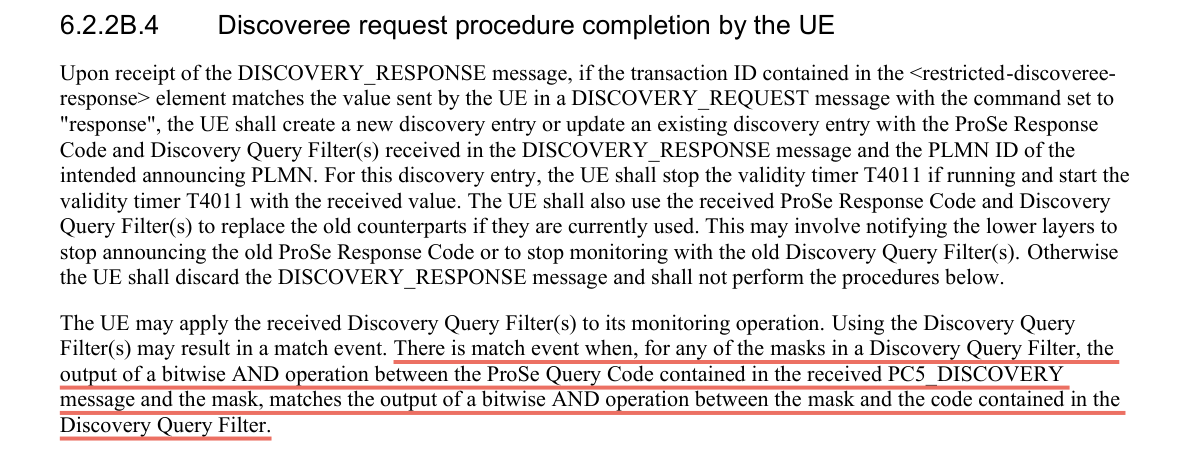
comparing in the one or more target devices the first representation of the identifier with the second representation of the identifier to obtain a comparison result for establishing a successful proximity discovery.
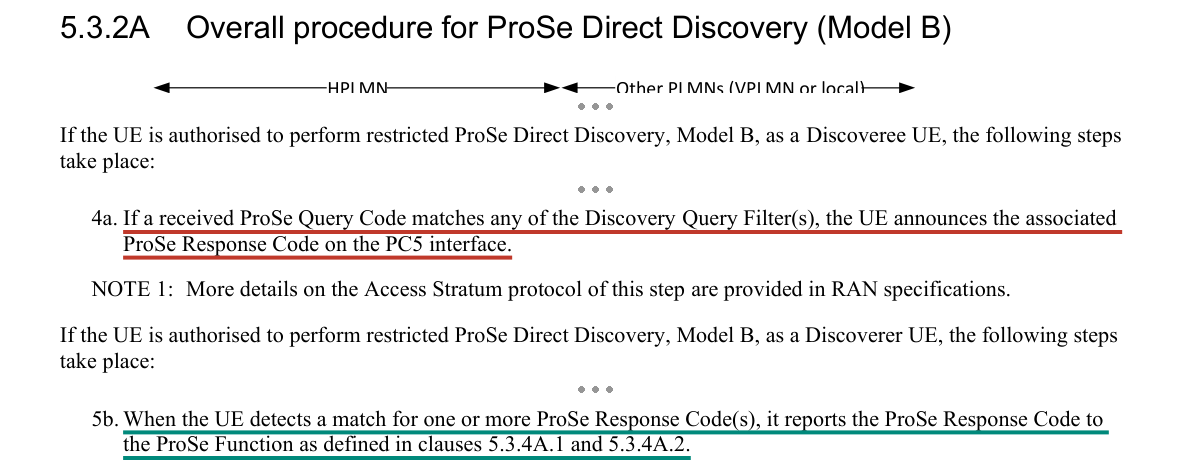
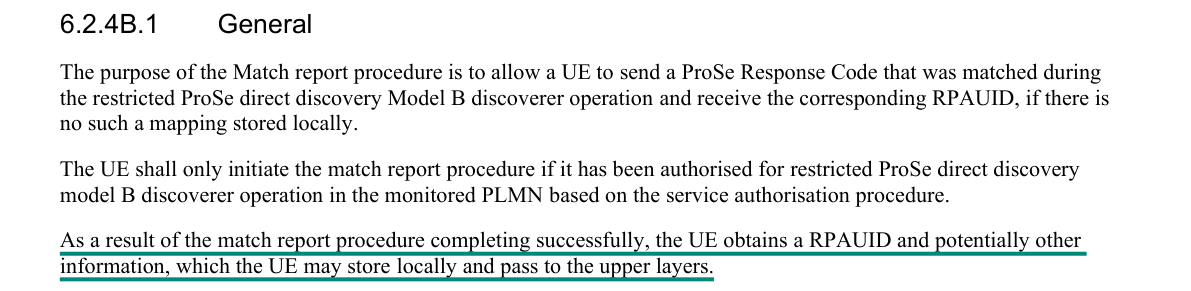
The Discoveree UE applies its Discovery Query Filter to the ProSe Query Code in the received message, after unscrambling the message contents with the DUSK, and a match event results. The standard has no sentence calling the discovery successful; the nearest outcome is the match report procedure, in which the Discoverer UE reports the matched ProSe Response Code, so it completes on the Discoverer UE's side (narrow reading).

Overall assessment
L1–L7 map to restricted ProSe direct discovery (Model B) in TS 23.303 and TS 24.334.
References
- TS 23.303 — Proximity-based services (ProSe); Stage 2
- TS 24.334 — Proximity-services (ProSe) User Equipment (UE) to ProSe function protocol aspects; Stage 3
- US9820134B2 — Proximity discovery, authentication and link establishment between mobile devices in 3GPP LTE (Google Patents)
this document is a technical essentiality assessment prepared for reference, comparing published patent documents against 3GPP standard specifications. It is not a legal determination or legal advice on the essentiality, validity or infringement of the patent. Before any material decision such as licensing or litigation, obtain a review by a qualified patent attorney or attorney at law.
Run it on your own patent
Enter a patent number and get the same chart for your claim. Your first report is free with a company email.
Get started