
US8761145B2 Claim 1 vs 3GPP TS 36.211: Sample Claim Chart
The content of a report SEPPi generated, shown as delivered. Reports are written in English.
Bibliographic data
- Patent number
- US8761145B2
- Title
- Wireless terminal apparatus and wireless base station apparatus
- Inventors
- Toshiaki Yamamoto, Feng Lu, Toshinori Suzuki
- Priority date
- 2006-10-31
- Filing date
- 2007-10-31
- Assignee
- Toyota Motor Corp
- Standard assessed
- E-UTRA physical uplink control channel, PUCCH formats 1, 1a and 1b (TS 36.211 §5.4.1) — Any 3GPP Rel-8 compliant UE / eNB
- Target release
- Rel-8 (TS 36.211 v8.9.0, TS 36.213 v8.8.0, TS 36.300 v8.12.0)
Claim 1 (independent)
A wireless terminal apparatus which encodes and transmits a control signal to a wireless base station apparatus, comprising: an encoding information receiving portion receiving encoding information which is used at the wireless terminal apparatus and which is transmitted from the wireless base station apparatus; an encoding portion which conducts an encoding operation on the control signal by using a predetermined first code, a second code which is an orthogonal code included in or calculated based on the encoding information and a phase shift amount based on the encoding information; and a transmission portion which transmits the encoded control signal, wherein the transmission portion modulates the control signal using a predetermined modulation method, and the second code includes (1, ej2π/3, e−j2π/3).
Standard under assessment
Rel-8 · TS 36.211 v8.9.0 · TS 36.213 v8.8.0 · TS 36.300 v8.12.0
Primary target: E-UTRA at Rel-8 — TS 36.211 v8.9.0 §5.4.1 (PUCCH formats 1, 1a and 1b) with §5.5.1 (reference signal sequence), §5.4.3 and §5.4, TS 36.213 v8.8.0 §10.1 (UE procedure for determining the PUCCH assignment) and TS 36.300 v8.12.0 §11.1 and §11.1.1 (eNB scheduling).
Release. No target release was requested and no product was identified, so the release is the one in which the claimed technology first enters the standard: the PUCCH format 1/1a/1b spreading clauses first appear in Rel-8, the lowest release available for these specifications, so Rel-8 is a lower bound. The NR counterpart (PUCCH format 1 of TS 38.211) first appears in Rel-15, so the E-UTRA family is the one charted and the families are not mixed.
Path. All rows are read on PUCCH format 1a/1b carrying HARQ-ACK for FDD, for a PDSCH transmission indicated by the detection of a corresponding PDCCH. The orthogonal sequence of length 3 named in the last row belongs to the second slot of the shortened PUCCH format 1/1a/1b (spreading length 3 there, length 4 in both slots of the normal formats), so the path is read in the shortened format; L1–L4 hold unchanged in it.
Claim chart
Matching colors mark corresponding elements between the claim and the standard. An underline in a screenshot marks the text the mapping rests on.
A wireless terminal apparatus which encodes and transmits a control signal to a wireless base station apparatus, comprising:
Context: the claimed apparatus is the UE, which for FDD uses a PUCCH resource to transmit HARQ-ACK (uplink control information sent on PUCCH format 1a or 1b); its counterpart is the eNB, which allocates the UE's resources dynamically through the PDCCH.



an encoding information receiving portion receiving encoding information which is used at the wireless terminal apparatus and which is transmitted from the wireless base station apparatus;
The UE uses a PUCCH resource for transmission of HARQ-ACK: for a PDSCH transmission indicated by the detection of a corresponding PDCCH, the resource is the number of the first CCE used for transmission of the corresponding DCI assignment plus a value configured by higher layers (the rendered clause reads n^(1)_PUCCH = n_CCE + N^(1)_PUCCH). The assignment is sent on the PDCCH by the eNB, whose MAC includes the dynamic resource schedulers that allocate resources to UEs on the PDCCH.



an encoding portion which conducts an encoding operation on the control signal by using a predetermined first code, a second code which is an orthogonal code included in or calculated based on the encoding information and a phase shift amount based on the encoding information; and
The HARQ-ACK symbol of PUCCH format 1a/1b is multiplied with a cyclically shifted length-12 sequence defined from a base sequence (first code) with a cyclic shift (phase shift amount), then scrambled and block-wise spread with the orthogonal sequence (second code). The PUCCH resource is identified by a resource index "from which the orthogonal sequence index and the cyclic shift are determined", so the orthogonal sequence is calculated based on it and the cyclic shift is based on it.
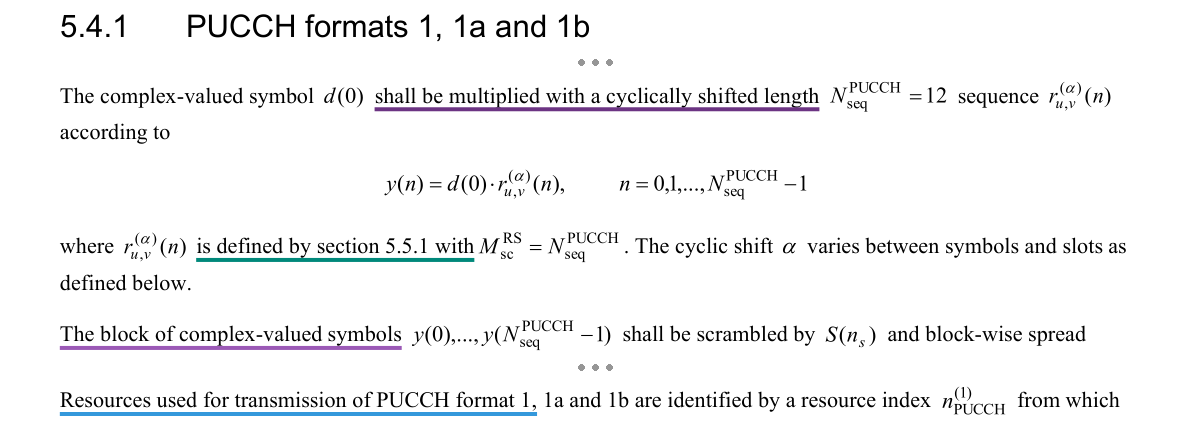


a transmission portion which transmits the encoded control signal,
The block of complex-valued symbols produced by the spreading is multiplied with the amplitude scaling factor to conform to the transmit power and mapped in sequence to resource elements; for FDD the UE uses its PUCCH resource for transmission of HARQ-ACK.


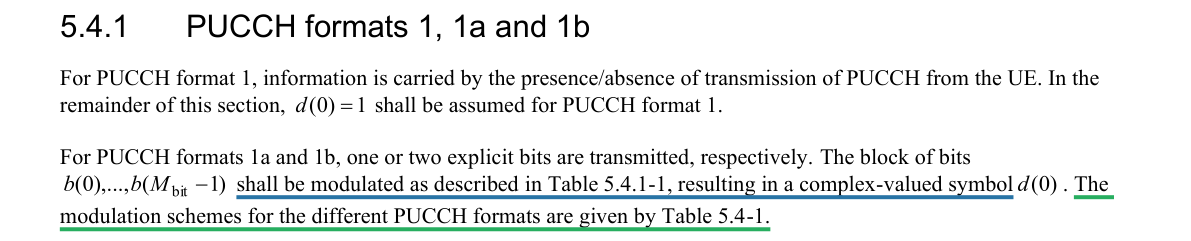
wherein the transmission portion modulates the control signal using a predetermined modulation method, and
The bits of HARQ-ACK on PUCCH format 1a or 1b are modulated as described in Table 5.4.1-1, resulting in a complex-valued symbol, and the modulation scheme of each PUCCH format is given by Table 5.4-1, so it is fixed in advance for the format.

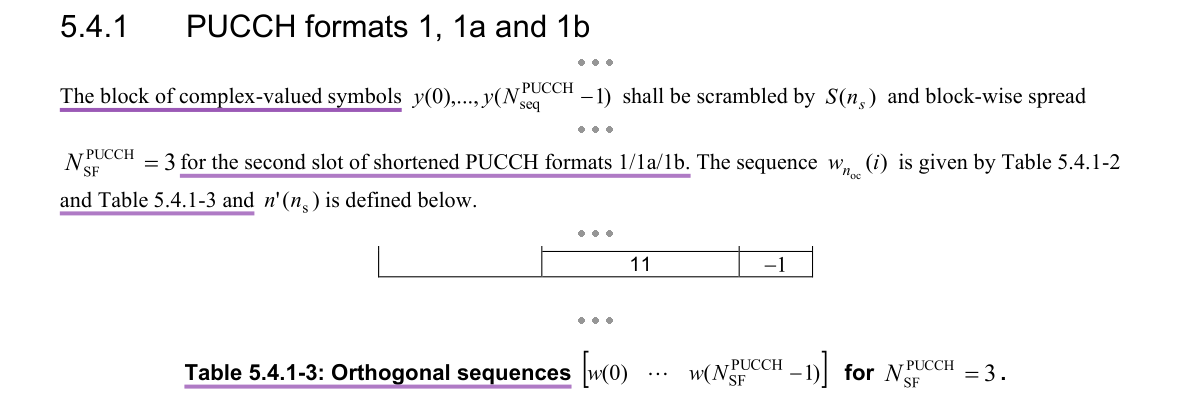
the second code includes (1, ej2π/3, e−j2π/3).
In the second slot of the shortened PUCCH format 1/1a/1b the spreading length is 3 and the orthogonal sequence is taken from Table 5.4.1-3 (orthogonal sequences for that length). On the rendered Rel-8 page, the table's sequence index 1 reads [1 e^(j2π/3) e^(j4π/3)]; e^(j4π/3) equals e^(−j2π/3), so the claimed values are that entry. The table rows are equation objects and are not reproduced in the picture.
Overall assessment
L1–L5 map to the standard.
References
- TS 36.211 — Evolved Universal Terrestrial Radio Access (E-UTRA); Physical channels and modulation
- TS 36.213 — Evolved Universal Terrestrial Radio Access (E-UTRA); Physical layer procedures
- TS 36.300 — Evolved Universal Terrestrial Radio Access (E-UTRA) and Evolved Universal Terrestrial Radio Access Network (E-UTRAN); Overall description; Stage 2
- US8761145B2 — Wireless terminal apparatus and wireless base station apparatus (Google Patents)
this document is a technical essentiality assessment prepared for reference, comparing published patent documents against 3GPP standard specifications. It is not a legal determination or legal advice on the essentiality, validity or infringement of the patent. Before any material decision such as licensing or litigation, obtain a review by a qualified patent attorney or attorney at law.
Run it on your own patent
Enter a patent number and get the same chart for your claim. Your first report is free with a company email.
Get started