
US11653305B2 Claim 1 vs 3GPP TS 38.321: Sample Claim Chart
The content of a report SEPPi generated, shown as delivered. Reports are written in English.
Bibliographic data
- Patent number
- US11653305B2
- Title
- Method for determining sleep state, terminal, and readable medium
- Inventors
- Huayu Zhou, Xinghang Gao, Zhikun XU
- Priority date
- 2018-08-10
- Filing date
- 2019-07-19
- Assignee
- Spreadtrum Communications Shanghai Co Ltd
- Standard assessed
- NR SCell dormancy indication by DCI (TS 38.213 §10.3, TS 38.212 §7.3.1.2.2, TS 38.321 §5.15.1) — Any 3GPP Rel-16 compliant UE / gNB
- Target release
- Rel-16 (TS 38.321 v16.22.0, TS 38.212 v16.15.0, TS 38.213 v16.17.0, TS 38.300 v16.22.0)
Claim 1 (independent)
A method for determining a sleep state, comprising: receiving sleep indication information through a Physical Downlink Control Channel (PDCCH) from a base station; and entering the sleep state and selecting a different mode based on the sleep indication information, wherein the mode comprises a first mode and a second mode, wherein the first mode indicates entering the sleep state, and that the PDCCH has scheduling information, and the second mode indicates entering the sleep state, and that the PDCCH has no scheduling information.
Standard under assessment
Rel-16 · TS 38.321 v16.22.0 · TS 38.212 v16.15.0 · TS 38.213 v16.17.0 · TS 38.300 v16.22.0
Primary target: NR SCell dormancy indication carried by DCI — TS 38.213 §10.3 (v16.17.0, Rel-16), read with TS 38.212 §7.3.1.2.2 and §7.3.1.1.2 (DCI formats 1_1 and 0_1, v16.15.0), TS 38.321 §3.1 and §5.15.1 (dormant BWP, v16.22.0) and TS 38.300 §10.2 and §10.6 (v16.22.0).
Release basis: Rel-16 is the release in which the claimed technology first appears in the standard. The SCell dormancy indication in DCI is present in the Rel-16 versions of the cited clauses and absent from their Rel-15 versions (TS 38.213 §10.3 does not exist in Rel-15); the introducing change requests are the Rel-16 UE power saving CRs of TS 38.213, TS 38.212, TS 38.300 and TS 38.321. The release follows the technology, not the priority date.
Branch charted: DCI-based SCell dormancy indication within DRX Active Time. The indication reaches the UE either in the SCell dormancy indication field of a DCI format 0_1 or 1_1 that also schedules data, or in a DCI format 1_1 that the UE considers as indicating SCell dormancy, not scheduling a PDSCH reception (TS 38.213 §10.3). The claim's first and second mode are read inside this one branch. The wake-up indication of DCI format 2_6 outside Active Time was not used: it carries no scheduling, so it could only read on the second mode.
Later releases: TS 38.300 §10.2 and §10.6, TS 38.321 §3.1 and §5.15.1 and TS 38.212 §7.3.1.1.2 read the same in Rel-19; TS 38.213 §10.3 and TS 38.212 §7.3.1.2.2 were reworded in later releases, so a Rel-19 chart needs its own check of those two.
Claim chart
Matching colors mark corresponding elements between the claim and the standard. An underline in a screenshot marks the text the mapping rests on.
A method for determining a sleep state, comprising:
The preamble's sleep state is read on the dormant BWP of an SCell: in the dormant BWP the UE stops monitoring PDCCH on or for that SCell and keeps performing CSI measurements, AGC and beam management.

receiving sleep indication information through a Physical Downlink Control Channel (PDCCH) from a base station; and
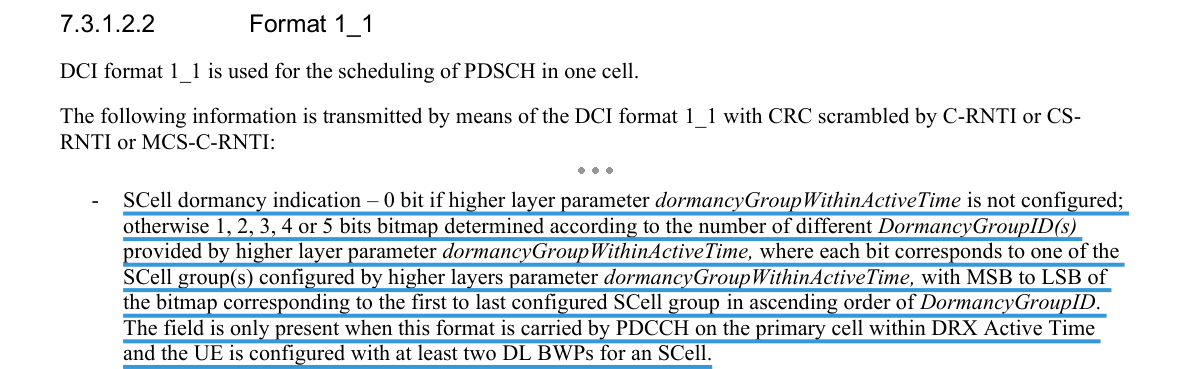
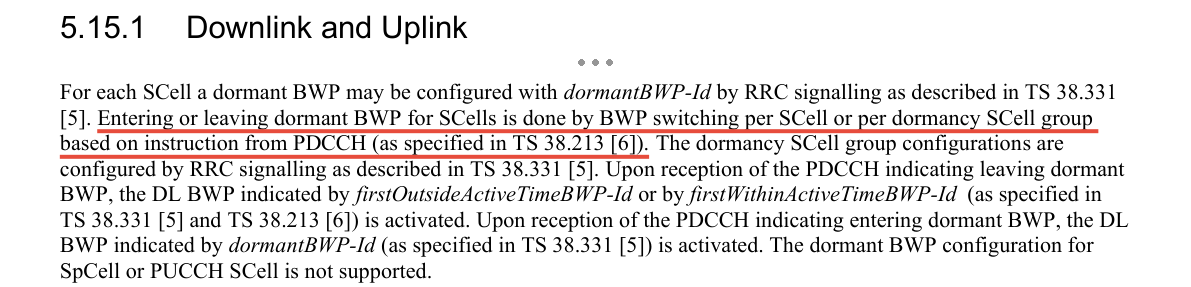
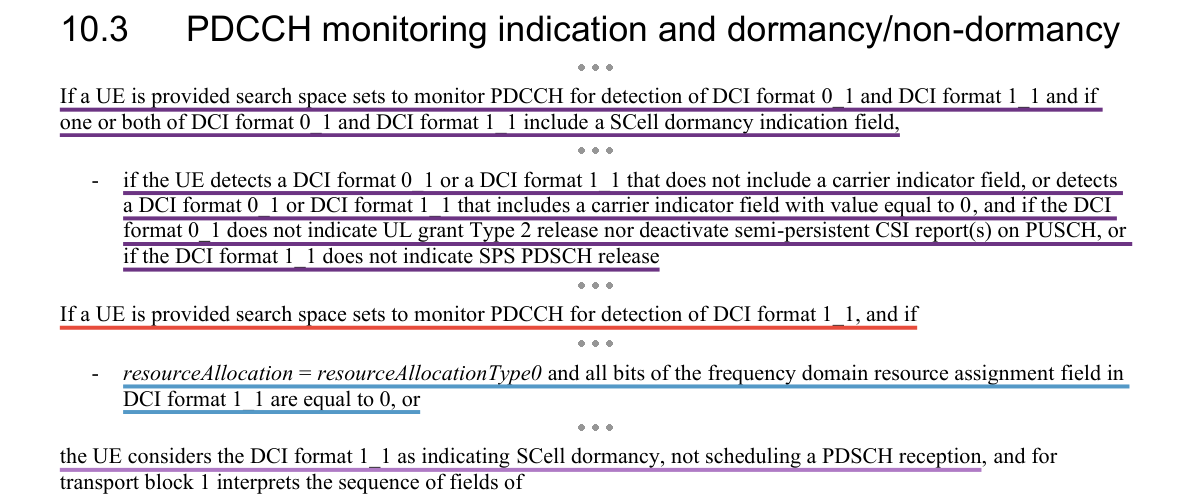
The SCell dormancy indication field is the sleep indication information: a bitmap with one bit per group of configured SCells, present only when the DCI format is carried by PDCCH on the primary cell within DRX Active Time, in DCI formats 0_1 and 1_1 that the UE monitors for. It is received through the PDCCH: entering or leaving the dormant BWP is done on instruction from PDCCH. The sender is the gNB, which allocates downlink resources to UEs on PDCCH and uses a DCI to control entering or leaving the dormant BWP.



entering the sleep state and selecting a different mode based on the sleep indication information,
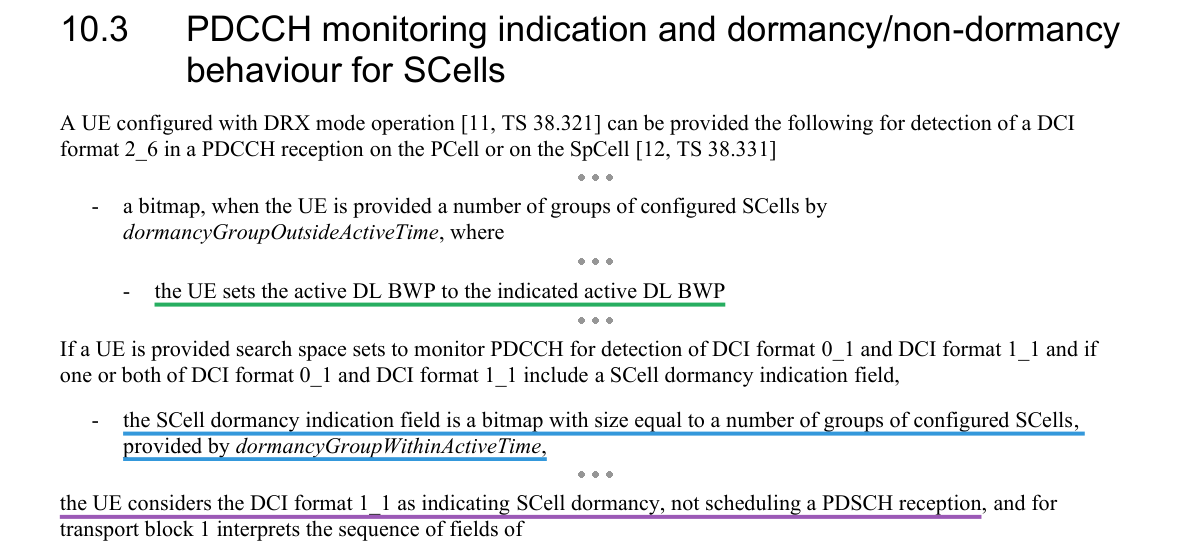
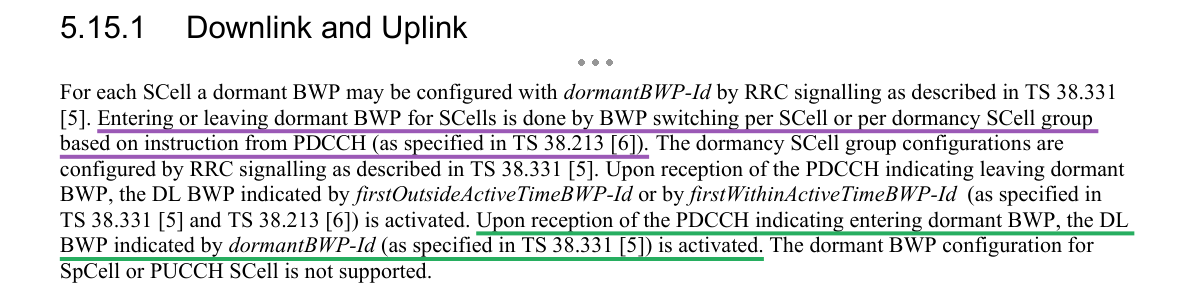
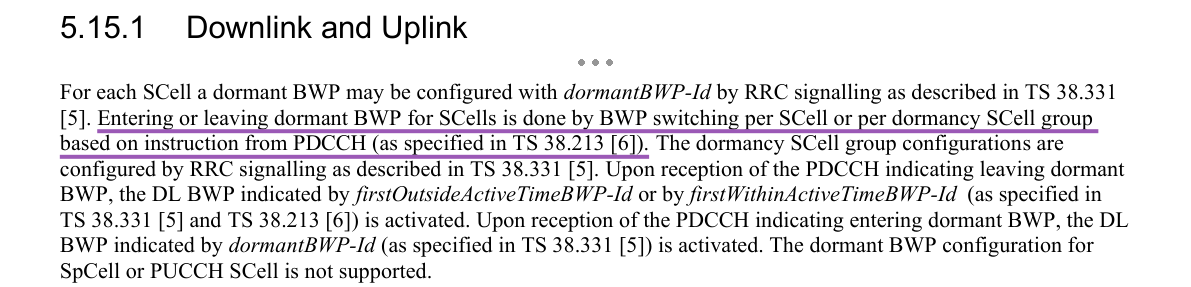
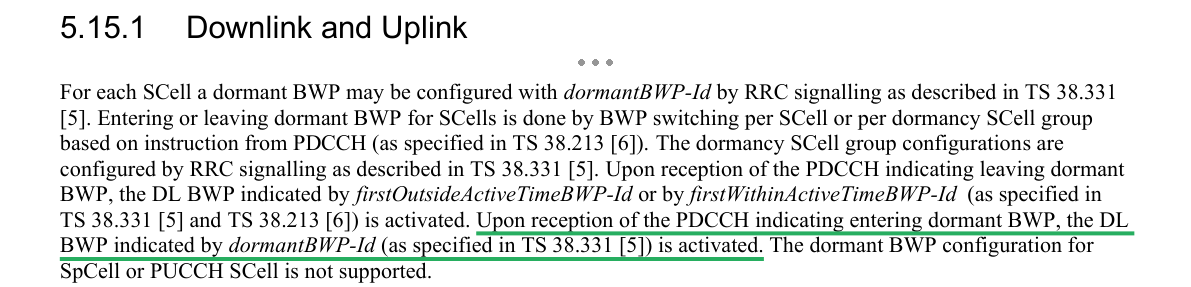
The UE enters the sleep state by switching to the dormant BWP: it sets the active DL BWP to the indicated BWP, and the DL BWP indicated by dormantBWP-Id is activated on reception of the PDCCH indicating entering the dormant BWP. The choice rests on the SCell dormancy indication field, a bitmap with one bit per group of configured SCells; it is applied as SCell dormancy, either by a DCI format 1_1 that the UE considers as indicating SCell dormancy, not scheduling a PDSCH reception, or by BWP switching per SCell or per dormancy SCell group on instruction from PDCCH.
wherein the mode comprises a first mode and a second mode,
The mode is the SCell dormancy applied on instruction from PDCCH, which comes in two forms. The first mode is carried by DCI format 0_1, which is used for the scheduling of PUSCH and, when it includes the SCell dormancy indication field, indicates dormancy. The second mode is carried by DCI format 1_1, which the UE considers as indicating SCell dormancy, not scheduling a PDSCH reception.


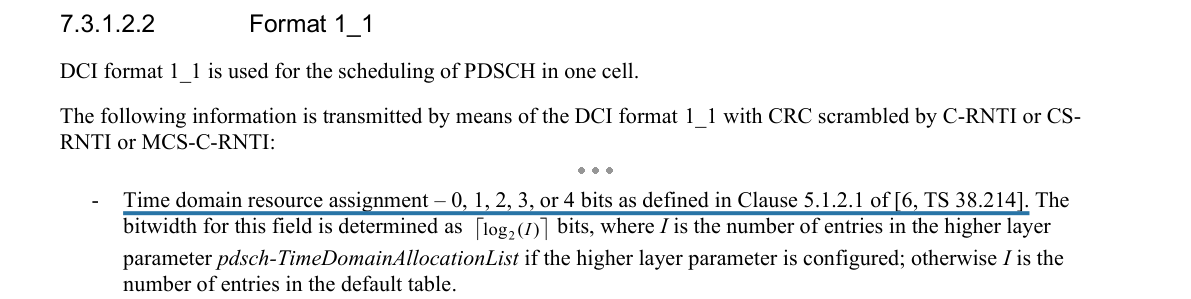
wherein the first mode indicates entering the sleep state, and that the PDCCH has scheduling information, and the second mode indicates entering the sleep state, and that the PDCCH has no scheduling information.
In the first mode the UE detects a DCI format 0_1 (or a DCI format 1_1) that includes the SCell dormancy indication field and does not release a UL grant or an SPS PDSCH, a scheduling DCI; its scheduling content is the Time domain resource assignment field. In the second mode the UE considers the DCI format 1_1 as indicating SCell dormancy, not scheduling a PDSCH reception, when all bits of the frequency domain resource assignment field are equal to 0 for resource allocation type 0. Both are received on the PDCCH that the UE monitors for detection of DCI format 1_1, and both lead the UE into the dormant BWP: on reception of the PDCCH indicating entering the dormant BWP, the DL BWP indicated by dormantBWP-Id is activated.

Overall assessment
L1–L4 map to the standard.
References
- TS 38.212 — NR; Multiplexing and channel coding
- TS 38.213 — NR; Physical layer procedures for control
- TS 38.300 — NR; NR and NG-RAN Overall Description; Stage 2
- TS 38.321 — NR; Medium Access Control (MAC) protocol specification
- US11653305B2 — Method for determining sleep state, terminal, and readable medium (Google Patents)
this document is a technical essentiality assessment prepared for reference, comparing published patent documents against 3GPP standard specifications. It is not a legal determination or legal advice on the essentiality, validity or infringement of the patent. Before any material decision such as licensing or litigation, obtain a review by a qualified patent attorney or attorney at law.
Run it on your own patent
Enter a patent number and get the same chart for your claim. Your first report is free with a company email.
Get started