
US11088795B2 Claim 9 vs 3GPP TS 38.211: Sample Claim Chart
The content of a report SEPPi generated, shown as delivered. Reports are written in English.
Bibliographic data
- Patent number
- US11088795B2
- Title
- Reference signal transmission device and reference signal transmission method
- Inventors
- Min Soo Na, Seung Young BAN, Chang Soon CHOI
- Priority date
- 2016-07-22
- Filing date
- 2017-05-16
- Assignee
- SK Telecom Co Ltd
- Standard assessed
- 3GPP NR reference signal mapping for the PDSCH — TS 38.211 §7.4.1.1.2 (PDSCH DM-RS) and §7.4.1.2.2 (PDSCH PT-RS) — Any 3GPP Rel-15 compliant gNB / UE
- Target release
- Rel-15 (TS 38.211 v15.10.0, TS 38.300 v15.23.0, TS 38.214 v15.16.0)
Claim 9 (independent)
A method for transmitting a reference signal by a base station or a terminal in a radio communication system, the method comprising: transmitting a first reference signal at a particular time point in a subframe of a radio resource for transmitting reference signal, the particular time point being determined based on a data channel; and transmitting a second reference signal for a particular duration in the subframe of the radio resource, the particular duration being determined based on a data channel, wherein the data channel is assigned to a symbol period in a plurality of symbols included in the subframe, the symbol period having consecutive symbols among the plurality of symbols, the particular time point corresponds to the first symbol of the symbol period where the transmission of the data channel is started, the transmission of the data channel and the transmission of the first reference signal are started at the first symbol of the symbol period in the frame, the particular duration corresponds to the symbol period in the subframe, and the data channel and the second reference signal are transmitted during the symbol period in the frame.
Standard under assessment
Rel-15 · TS 38.211 v15.10.0 · TS 38.300 v15.23.0 · TS 38.214 v15.16.0
Primary target: the NR physical-layer mapping of the PDSCH demodulation reference signal (DM-RS) and the PDSCH phase-tracking reference signal (PT-RS) as of Rel-15 — TS 38.211 v15.10.0 §7.4.1.1.2 and §7.4.1.2.2, with the PDSCH time-domain allocation in TS 38.214 v15.16.0 §5.1.2.1, the frame structure in TS 38.211 v15.10.0 §4.3.1, §4.3.2 and §4.4.2, and the gNB definition and physical-layer overview in TS 38.300 v15.23.0 §4.1 and §5.2.2.
Release. Rel-15 is the first release in which TS 38.211 and TS 38.214 exist, and the cited DM-RS and PT-RS mapping clauses are present from that release; the chart is written against Rel-15 only. The DM-RS mapping sentences of §7.4.1.1.2 read the same in Rel-19; four other cited clauses (TS 38.211 §4.3.1, §4.4.2, §7.4.1.2.2 and TS 38.214 §5.1.2.1) are worded differently in Rel-19, so those rows would need a separate check for that release.
Path. The rows are read on one path: a base station (gNB) transmitting the PDSCH with its DM-RS and PT-RS, PDSCH mapping type B, in which the first DM-RS symbol is defined relative to the start of the scheduled PDSCH resources (mapping type A is defined relative to the start of the slot). The terminal alternative of the claim ("a base station or a terminal") reads on the same structure in the uplink (PUSCH mapping type B and the PUSCH PT-RS), shown in row P. The standard words these steps from the UE side ("the UE shall assume …"); the network-side transmission is read as the other side of those sentences. PT-RS is an optional feature of the standard, present only where it has been configured.
Claim chart
Matching colors mark corresponding elements between the claim and the standard. An underline in a screenshot marks the text the mapping rests on.
A method for transmitting a reference signal by a base station or a terminal in a radio communication system, the method comprising:
Context: the claimed method is carried out either by a gNB, the NR node that transmits the PDSCH together with its DM-RS, or by a UE, which in the uplink transmits the PT-RS with its PUSCH.



transmitting a first reference signal at a particular time point in a subframe of a radio resource for transmitting reference signal, the particular time point being determined based on a data channel; and
The PDSCH DM-RS is mapped to physical resources in the symbols of a subframe of the resource grid. For PDSCH mapping type B the position of its first symbol, the first DM-RS symbol, is defined relative to the start of the scheduled PDSCH resources, so the time point follows the data channel. The standard words the transmission from the UE side ("The UE shall assume the PDSCH DM-RS being mapped …"); the gNB sending is the other side of that sentence.



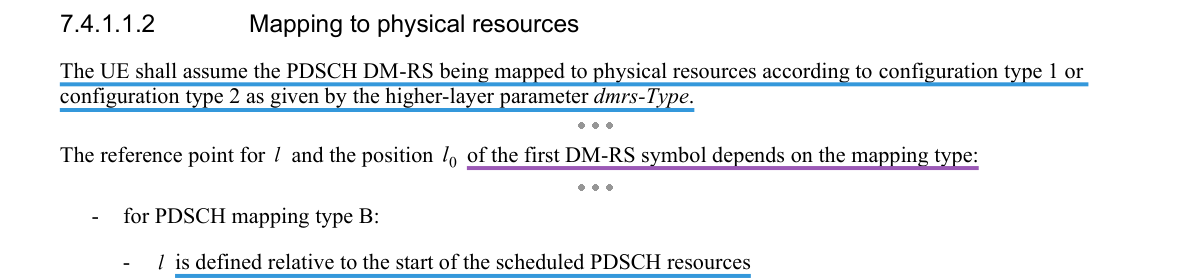

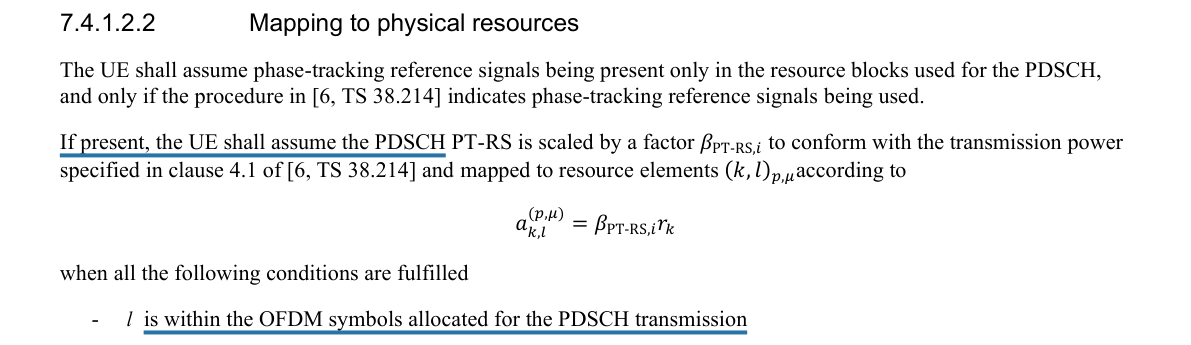
transmitting a second reference signal for a particular duration in the subframe of the radio resource, the particular duration being determined based on a data channel,
The phase-tracking reference signals are present in the resource blocks used for the PDSCH and are mapped only to the OFDM symbols allocated for the PDSCH transmission, so the duration of the second signal is set by the PDSCH allocation. They sit in the same subframe of the resource grid. PT-RS is an optional feature: it is present only where the network has configured phase-tracking reference signals for the UE.


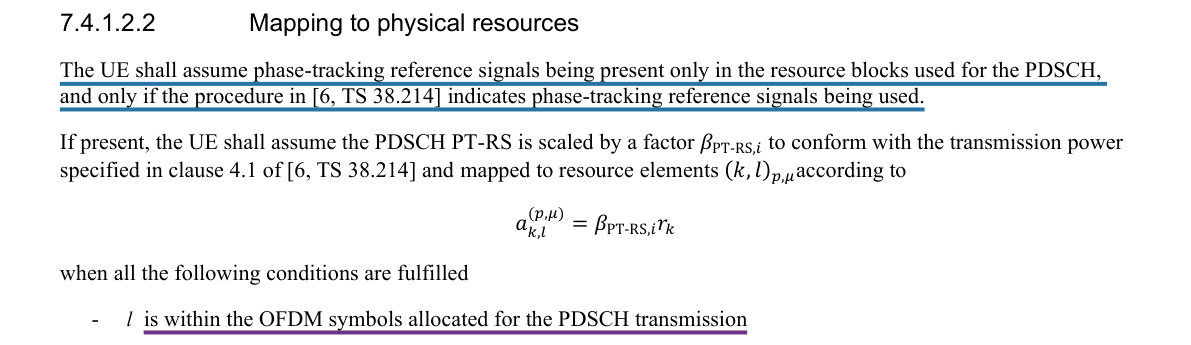

wherein the data channel is assigned to a symbol period in a plurality of symbols included in the subframe, the symbol period having consecutive symbols among the plurality of symbols,
The PDSCH is allocated a start symbol and a number of consecutive symbols: "the number of consecutive symbols L counting from the symbol S allocated for the PDSCH" — the consecutive symbols L. These symbols belong to the subframe, which consists of OFDM symbols (the number of consecutive OFDM symbols per subframe is fixed by the slot structure).

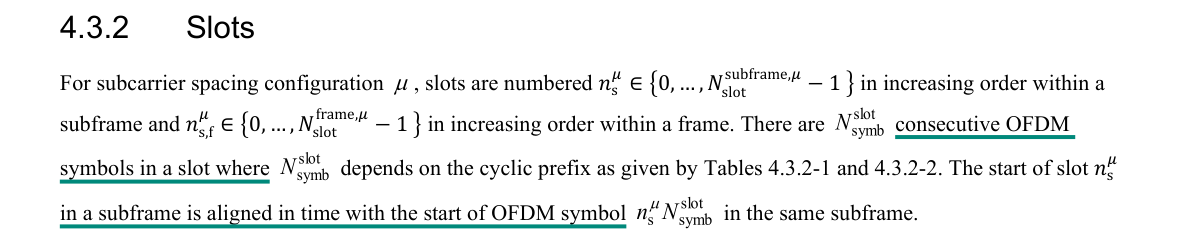

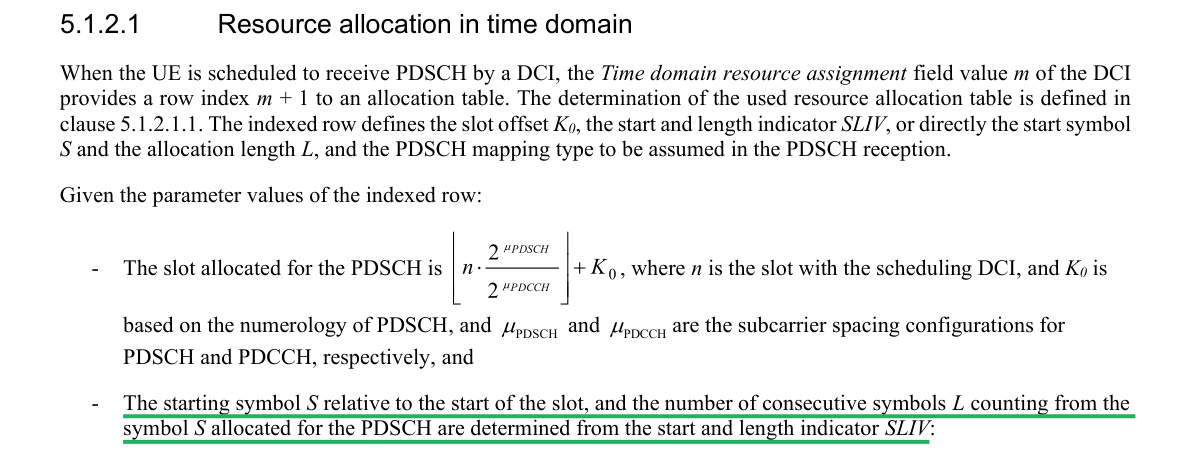

the particular time point corresponds to the first symbol of the symbol period where the transmission of the data channel is started,
For PDSCH mapping type B the first DM-RS symbol is defined relative to the start of the scheduled PDSCH resources, which is the starting symbol S of the allocation — the first of the consecutive symbols L allocated for the PDSCH. This holds for mapping type B; the position moves later when the front-loaded DM-RS collides with a CORESET.
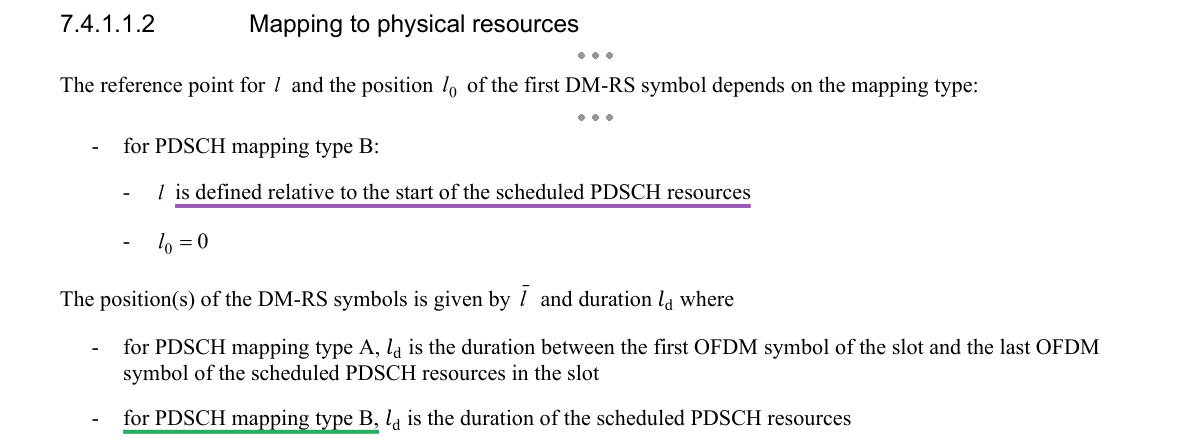
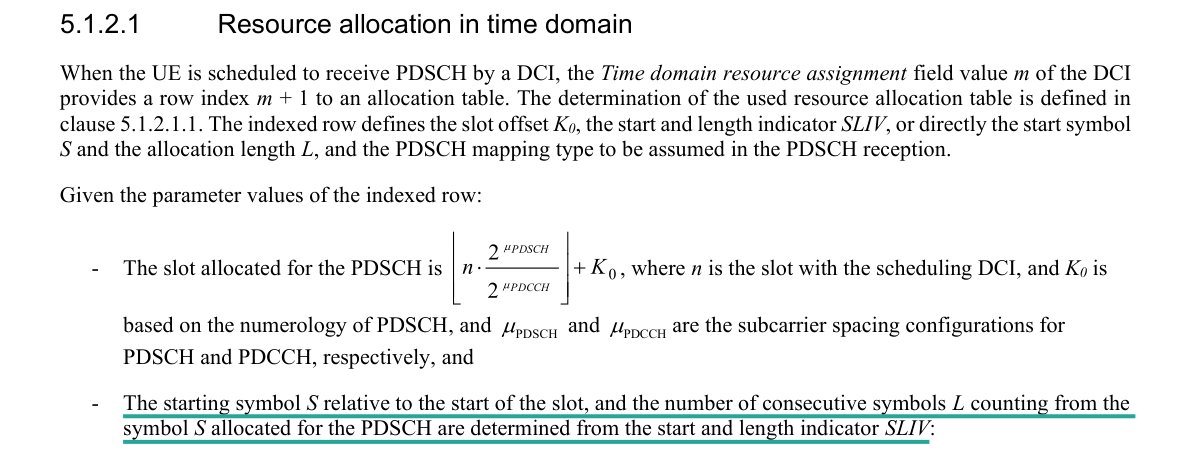

the transmission of the data channel and the transmission of the first reference signal are started at the first symbol of the symbol period in the frame,
The PDSCH transmission starts at the starting symbol S of the allocation, and for mapping type B the PDSCH DM-RS position is defined relative to the start of the scheduled PDSCH resources, so it starts at the same symbol. Both lie in the consecutive symbols L of the allocation within the subframe (the claim's "frame").

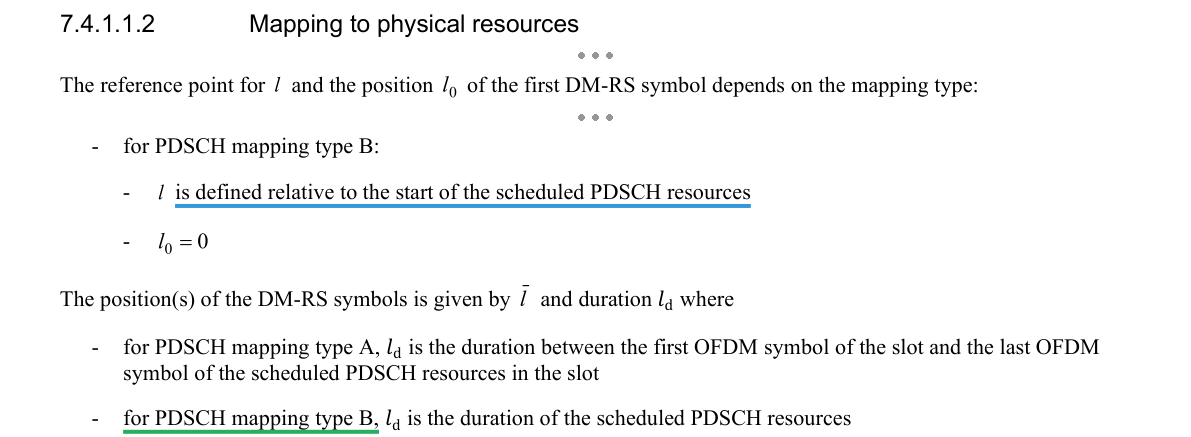
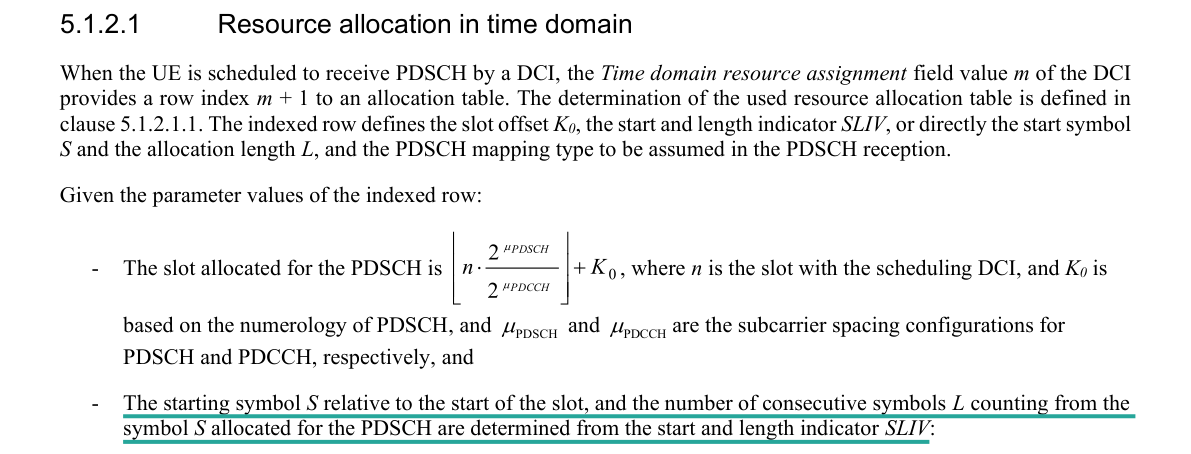

the particular duration corresponds to the symbol period in the subframe, and
The OFDM symbols allocated for the PDSCH transmission, in which the PT-RS is mapped, are the symbols of the scheduled PDSCH resources; the consecutive symbols L of the allocation have the duration l_d of those resources. The two coincide within the subframe.


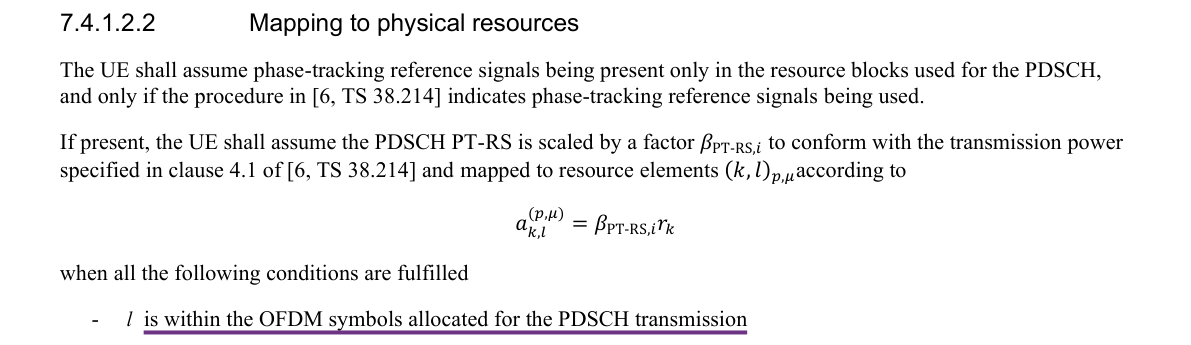
the data channel and the second reference signal are transmitted during the symbol period in the frame.
The PDSCH and the phase-tracking reference signals are transmitted in the same consecutive symbols L of the allocation: the PT-RS is mapped to resource elements within the OFDM symbols allocated for the PDSCH transmission, in the subframe. The PT-RS occupies the symbols l_ref + i·L_PT-RS (L_PT-RS ∈ {1,2,4}), so every symbol only when L_PT-RS = 1; it is an optional feature.



Overall assessment
L1–L7 map to the standard: the Rel-15 PDSCH DM-RS and PT-RS mapping, with the PDSCH allocation of consecutive symbols (PDSCH mapping type B).
References
- TS 38.211 — NR; Physical channels and modulation
- TS 38.214 — NR; Physical layer procedures for data
- TS 38.300 — NR; NR and NG-RAN Overall Description; Stage 2
- US11088795B2 — Reference signal transmission device and reference signal transmission method (Google Patents)
this document is a technical essentiality assessment prepared for reference, comparing published patent documents against 3GPP standard specifications. It is not a legal determination or legal advice on the essentiality, validity or infringement of the patent. Before any material decision such as licensing or litigation, obtain a review by a qualified patent attorney or attorney at law.
Run it on your own patent
Enter a patent number and get the same chart for your claim. Your first report is free with a company email.
Get started