
US10680779B2 Claim 10 vs 3GPP TS 38.213: Sample Claim Chart
The content of a report SEPPi generated, shown as delivered. Reports are written in English.
Bibliographic data
- Patent number
- US10680779B2
- Title
- Method for allocating control resource set, method for acquiring control resource set, base station, user equipment and readable medium
- Inventors
- Huayu Zhou, Yanan Jia, Shaofei Wang
- Priority date
- 2017-08-11
- Filing date
- 2018-08-09
- Assignee
- Spreadtrum Communications Shanghai Co Ltd
- Standard assessed
- NR CORESET configuration for the Type0-PDCCH common search space — TS 38.213 §13, TS 38.331 §6.2.2 — Any 3GPP Rel-15 compliant UE / gNB
- Target release
- Rel-15 (TS 38.213 v15.15.0, TS 38.331 v15.30.0, TS 38.211 v15.10.0, TS 38.300 v15.23.0)
Claim 10 (independent)
A method for acquiring Control Resource Set (CORESET), comprising: a User Equipment (UE) receiving configuration information from a base station, wherein the configuration information comprises time position information of at least one CORESET, and position information of the at least one CORESET in a system frame number, wherein the time position information comprises: the number of symbols occupied by the at least one CORESET, or the number of symbols occupied by the at least one CORESET and a start position of the at least one CORESET, wherein the symbols comprises symbols in a numerology used by the at least one CORESET; and selecting the start position of the at least one CORESET based on the configuration information, and a preset table of relation between the number of symbols occupied by the CORESET and the start position of the CORESET.
Standard under assessment
Rel-15 · TS 38.213 v15.15.0 · TS 38.331 v15.30.0 · TS 38.211 v15.10.0 · TS 38.300 v15.23.0
Primary target: TS 38.213 §13 (UE procedure for monitoring Type0-PDCCH CSS sets), read with TS 38.213 §4.1, TS 38.331 §5.2.2.4, §6.2.2 and §6.3.2, TS 38.211 §4.2 and §7.3.2.2, and TS 38.300 §7.3.1, all at Rel-15 (TS 38.213 v15.15.0, TS 38.331 v15.30.0, TS 38.211 v15.10.0, TS 38.300 v15.23.0). The control resource set exists only in the NR specifications; Rel-15 is the earliest release of those specifications available at the date of analysis, and the cited clauses are present in it (the introducing change request was not identified). The mapping follows the branch of clause 13 for SS/PBCH block and CORESET multiplexing pattern 1 (Tables 13-11 and 13-12); patterns 2 and 3 (Tables 13-13 to 13-15) give the first symbol index by SS/PBCH block index and are not used. It applies where the MIB provides a CORESET for the Type0-PDCCH CSS set. TS 38.213 §13, TS 38.211 §4.2 and part of TS 38.331 §6.2.2 are worded differently in the latest release (Rel-19); this chart addresses Rel-15 only.
Claim chart
Matching colors mark corresponding elements between the claim and the standard. An underline in a screenshot marks the text the mapping rests on.
A method for acquiring Control Resource Set (CORESET), comprising:
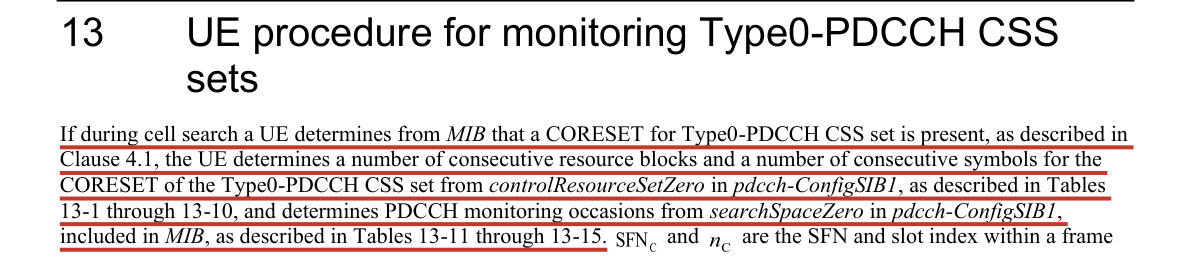
The claimed activity is the UE acquiring a CORESET: upon detecting an SS/PBCH block the UE determines from the MIB that a CORESET for the Type0-PDCCH CSS set is present, and clause 13 then describes how that CORESET is determined.

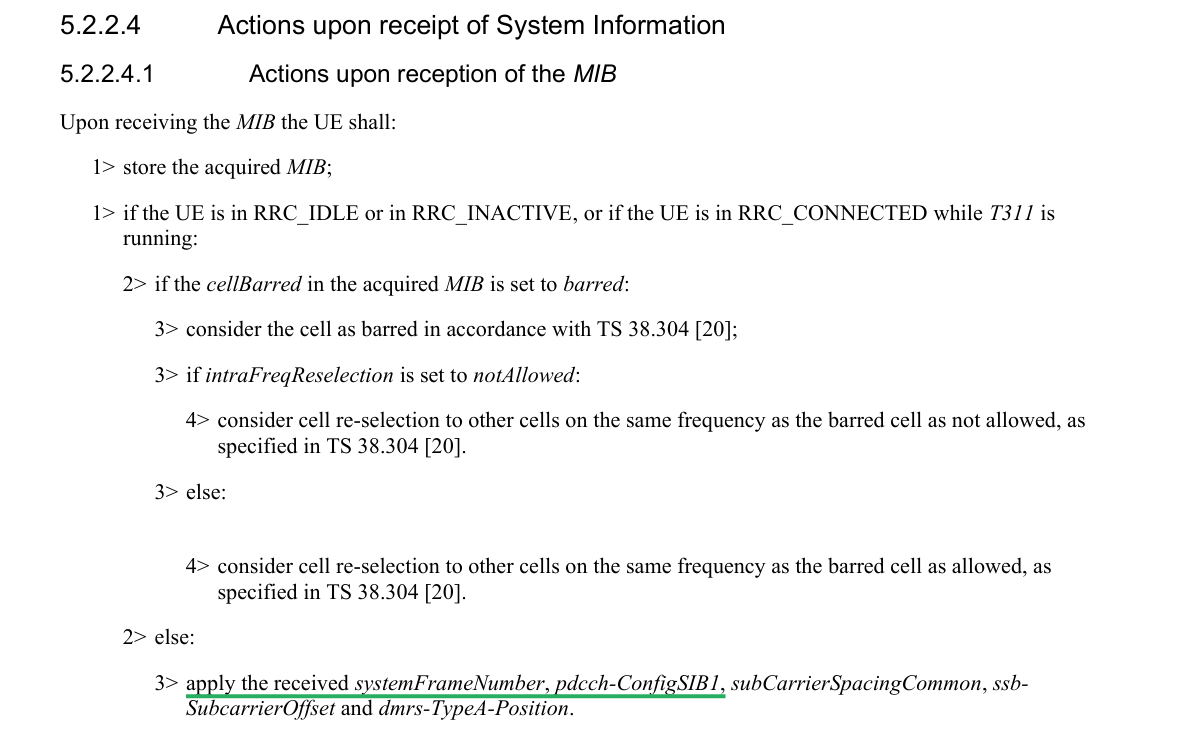
a User Equipment (UE) receiving configuration information from a base station,
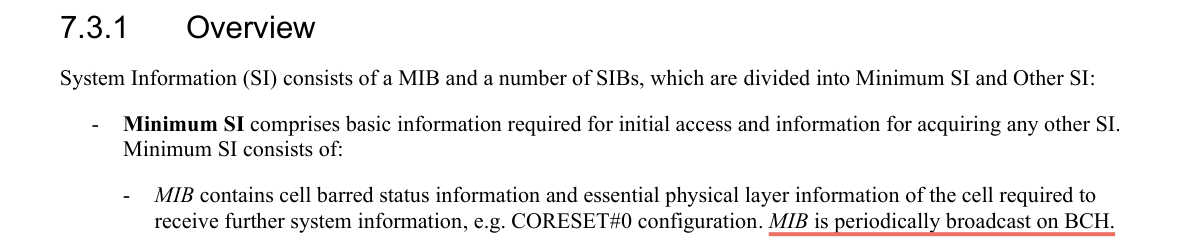
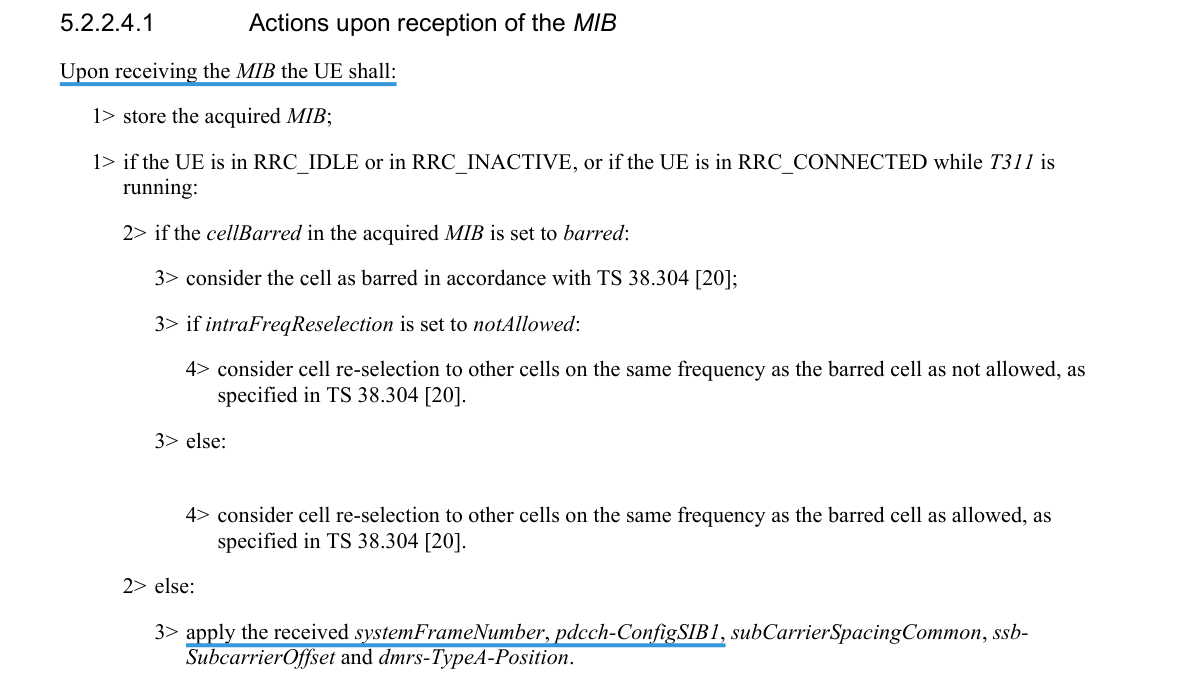
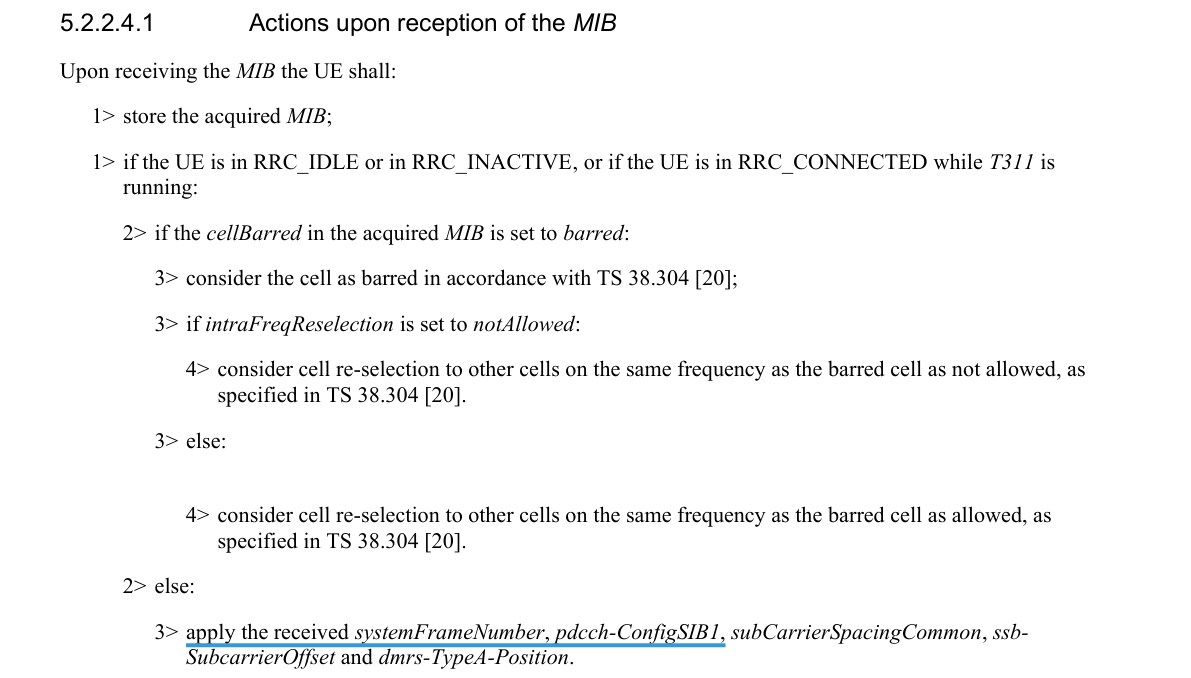
The UE determines the CORESET parameters during cell search, using what the MIB carries. Upon receiving the MIB the UE applies the received pdcch-ConfigSIB1, which is the configuration information for the CORESET. The gNB is the sending end: the MIB is defined as Direction: Network to UE and is periodically broadcast on BCH. The MIB is the container; the pdcch-ConfigSIB1 field inside it is the configuration information. This holds where the MIB provides a CORESET for the Type0-PDCCH CSS set (the UE determines from the MIB whether one is present).

wherein the configuration information comprises time position information of at least one CORESET, and position information of the at least one CORESET in a system frame number,
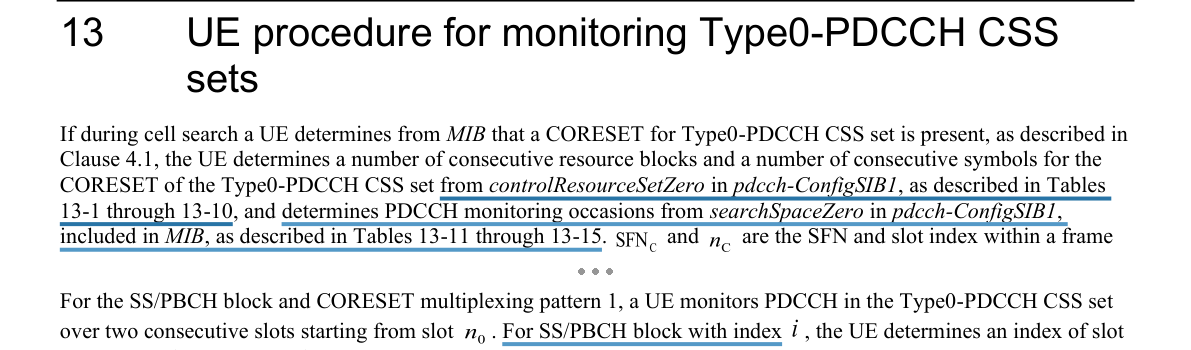
The configuration information is the pdcch-ConfigSIB1 field of the MIB, which determines a common ControlResourceSet (CORESET), a common search space and necessary PDCCH parameters. Time position information is controlResourceSetZero in pdcch-ConfigSIB1: the UE determines the number of consecutive symbols for the CORESET from it, as described in Tables 13-1 through 13-10. The CORESET is the one the UE determines from the MIB for the Type0-PDCCH CSS set. Position information is searchSpaceZero in pdcch-ConfigSIB1: the UE determines the PDCCH monitoring occasions from it, and the slot is located in a frame with a given SFN. The system frame number is carried by the systemFrameNumber field of the MIB (the 6 most significant bits of the 10-bit System Frame Number) and applied on reception. Reading: controlResourceSetZero is an index into Tables 13-1 to 13-10 that fixes the number of symbols, and pdcch-ConfigSIB1 is the container that also carries searchSpaceZero; searchSpaceZero fixes the frame (SFN) and slot of the monitoring occasions rather than a stated position of the CORESET itself. This holds where the MIB provides a CORESET for the Type0-PDCCH CSS set.



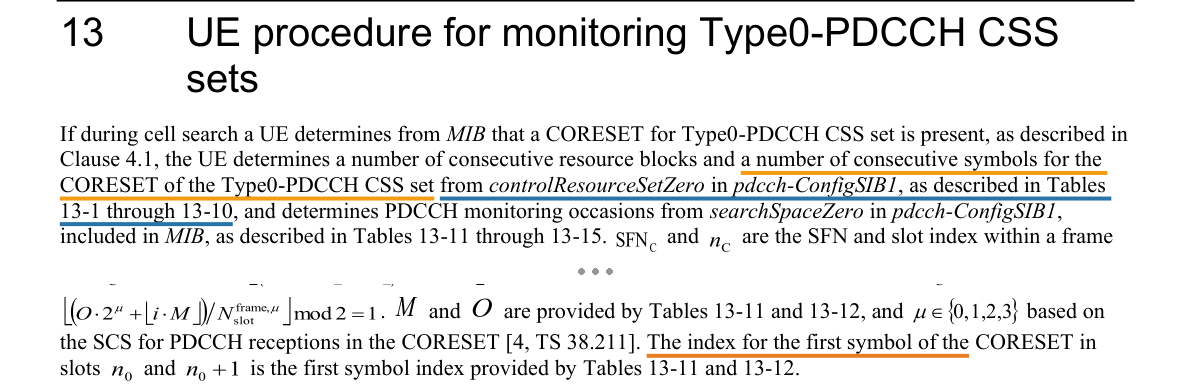
wherein the time position information comprises: the number of symbols occupied by the at least one CORESET, or the number of symbols occupied by the at least one CORESET and a start position of the at least one CORESET,
The time position information is controlResourceSetZero. First form: the number of symbols is the number of consecutive symbols that the UE determines for the CORESET of the Type0-PDCCH CSS set. A CORESET consists of N_RB^CORESET resource blocks in the frequency domain and N_symb^CORESET symbols in the time domain, N_symb^CORESET ∈ {1,2,3}. Second form: the start position is the first symbol index; the index for the first symbol of the CORESET is the first symbol index provided by Tables 13-11 and 13-12. Reading: in the second form the start position is provided through searchSpaceZero (Tables 13-11 and 13-12), not through controlResourceSetZero, which carries the number of symbols; the first form (the number of symbols alone) carries the row.

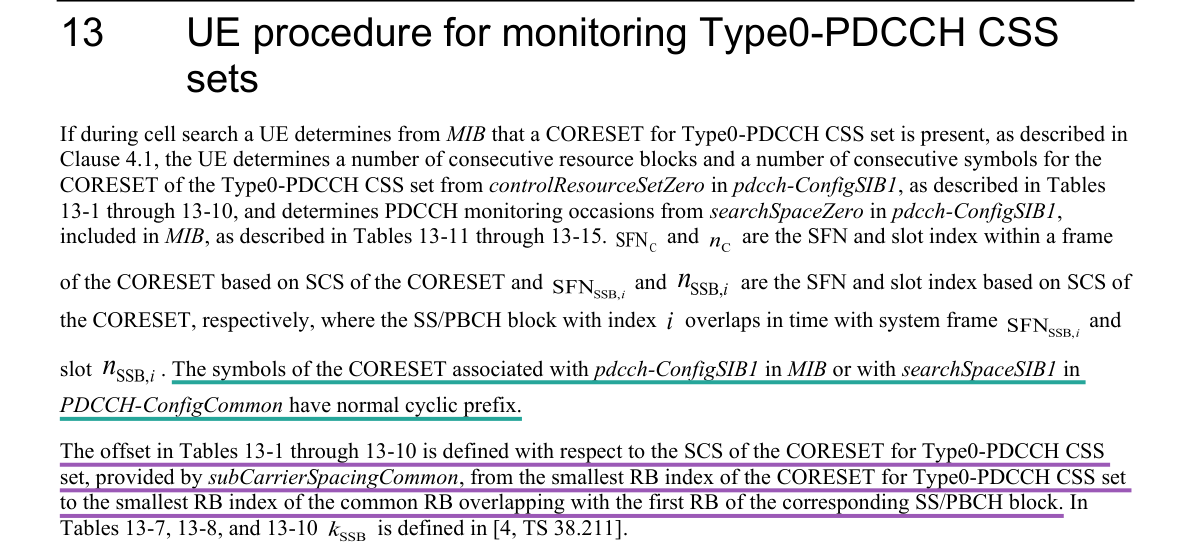
wherein the symbols comprises symbols in a numerology used by the at least one CORESET; and
The symbols of the CORESET are its symbols in the time domain (N_symb^CORESET ∈ {1,2,3}), and they have normal cyclic prefix. The numerology used by the CORESET is given by subCarrierSpacingCommon: the SCS of the CORESET is the one provided by subCarrierSpacingCommon, and a numerology is obtained from the subcarrier spacing and the cyclic prefix (TS 38.211 §4.2). The CORESET is the one determined from the MIB for the Type0-PDCCH CSS set. Reading: the numerology is read on subCarrierSpacingCommon, the subcarrier-spacing part of the numerology; the cyclic-prefix part is the normal cyclic prefix of the CORESET symbols.




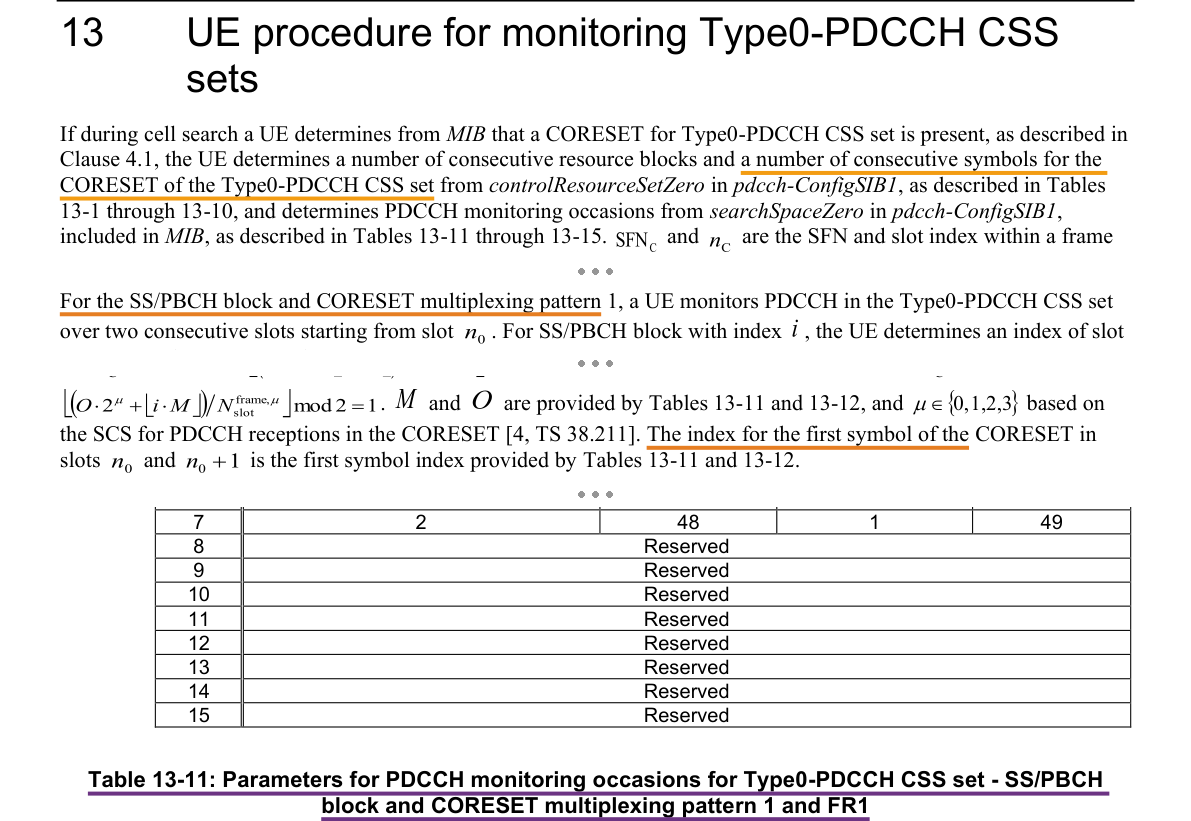
selecting the start position of the at least one CORESET based on the configuration information, and a preset table of relation between the number of symbols occupied by the CORESET and the start position of the CORESET.
The UE selects the start position: a UE monitors PDCCH in the Type0-PDCCH CSS set starting from a slot, and the index for the first symbol of the CORESET in those slots is the first symbol index provided by Tables 13-11 and 13-12. The CORESET is the one determined from the MIB for the Type0-PDCCH CSS set. The selection rests on the received pdcch-ConfigSIB1, which the UE applies on receiving the MIB. The number of symbols is the number of consecutive symbols determined for the CORESET. The preset table is Table 13-11 (Table 13-12 is its FR2 counterpart), the fixed table of the standard that gives the first symbol index. Reading: in Table 13-11 the first symbol index of indices 1, 3, 5 and 7 is 0 for even i and N_symb^CORESET for odd i, so the start position follows from the number of symbols; the other entries are fixed values. The selecting step is read on the sentence whose subject is the UE (it monitors from a starting slot) together with the first-symbol-index sentence, which has no subject of its own.

Overall assessment
L1–L5 map to the standard, read on the MIB-configured CORESET for the Type0-PDCCH common search space (SS/PBCH block and CORESET multiplexing pattern 1).
References
- TS 38.211 — NR; Physical channels and modulation
- TS 38.213 — NR; Physical layer procedures for control
- TS 38.300 — NR; NR and NG-RAN Overall Description; Stage 2
- TS 38.331 — NR; Radio Resource Control (RRC) protocol specification
- US10680779B2 — Method for allocating control resource set, method for acquiring control resource set, base station, user equipment and readable medium (Google Patents)
this document is a technical essentiality assessment prepared for reference, comparing published patent documents against 3GPP standard specifications. It is not a legal determination or legal advice on the essentiality, validity or infringement of the patent. Before any material decision such as licensing or litigation, obtain a review by a qualified patent attorney or attorney at law.
Run it on your own patent
Enter a patent number and get the same chart for your claim. Your first report is free with a company email.
Get started