
EP3410774B1 Claim 1 vs 3GPP TS 23.214: Sample Claim Chart
The content of a report SEPPi generated, shown as delivered. Reports are written in English.
Bibliographic data
- Patent number
- EP3410774B1
- Title
- Method and gateway for transmitting downlink packet in function-separated core network
- Inventors
- Sangsoo Jeong
- Priority date
- 2016-01-25
- Filing date
- 2016-11-18
- Assignee
- SK Telecom Co Ltd
- Standard assessed
- TS 23.214 (Architecture enhancements for control and user plane separation of EPC nodes; Stage 2) §5.9.3 and TS 29.244 (Interface between the Control Plane and the User Plane Nodes; Stage 3) §5.2.4 — Any 3GPP Rel-14 compliant EPC with control and user plane separation (SGW-C / SGW-U)
- Target release
- Rel-14 (TS 23.214 v14.9.0, TS 29.244 v14.8.0, TS 23.401 v14.11.0)
Claim 1 (independent)
A method for transmitting a downlink packet to a user equipment, UE (110), in an idle mode in a mobile communication system in which a gateway is separated into a user plane node (142) and a control plane node (134), the method comprising: informing, by the control plane node (134), the user plane node (142) of information for receiving the downlink packet for the UE (110); receiving and buffering, by the user plane node (142), the downlink packet for the UE (110); transmitting, by the user plane node (142), a notification message of a reception of the downlink packet to the control plane node (134); and transmitting, by the user plane node (142), the buffered downlink packet to the UE (110) through a base station (120), characterized in that the user plane node (142) delays the notification message of the reception of the downlink packet to the control plane node (134) until a preset buffering time elapses, wherein the information includes the preset buffering time.
Standard under assessment
Rel-14 · TS 23.214 v14.9.0 · TS 29.244 v14.8.0 · TS 23.401 v14.11.0
Primary target: TS 23.214 v14.9.0 (Rel-14), *Architecture enhancements for control and user plane separation of EPC nodes*, §5.9 "Idle state packet SGW buffering function", together with TS 29.244 v14.8.0 (Rel-14), *Interface between the Control Plane and the User Plane Nodes*, §5.2.4 "Buffering Action Rule Handling" and §8.2.28 "Downlink Data Notification Delay". TS 23.401 v14.11.0 §4.6.3.1 supplies the definition of the idle state (ECM-IDLE).
The claim describes a gateway split into a control plane node and a user plane node, which the standard defines as the SGW-C and the SGW-U of the EPC with control and user plane separation (introduced in Rel-14). The 5G system's buffering at the user plane function is a later feature, so the EPC family is charted.
The chart follows one branch of TS 23.214 §5.9.3.2: the one in which "the parameter D is handled by the SGW-U". There the SGW-C hands the delay D to the SGW-U, the SGW-U buffers the downlink data and delays its report to the SGW-C. This is not the default flow of §5.9.3.1, in which the SGW-U reports the first downlink packet at once; rows L5 and L6 hold only on the delay branch. In the other branch of §5.9.3.2 the SGW-C, not the SGW-U, delays a different notification (to the MME).
The wording of most cited clauses is the same in the latest release; three clauses of TS 29.244 (§5.1, §5.2.4.1, §5.2.4.2) were reworded after Rel-14, so a separate chart for the latest release may be needed. The delay of rows L5 and L6 is optional in the standard: it applies when the UP function indicates support of the Downlink Data Notification Delay parameter and the delay D has been provided.
Claim chart
Matching colors mark corresponding elements between the claim and the standard. An underline in a screenshot marks the text the mapping rests on.
A method for transmitting a downlink packet to a user equipment, UE (110), in an idle mode in a mobile communication system in which a gateway is separated into a user plane node (142) and a control plane node (134), the method comprising:
Context: the claimed method runs in the architecture reference model with Control and User Plane Separation of EPC nodes, where the SGW is split into the SGW-C and the SGW-U. The SGW-U buffers and forwards the downlink packet of a UE that is in ECM-IDLE state.



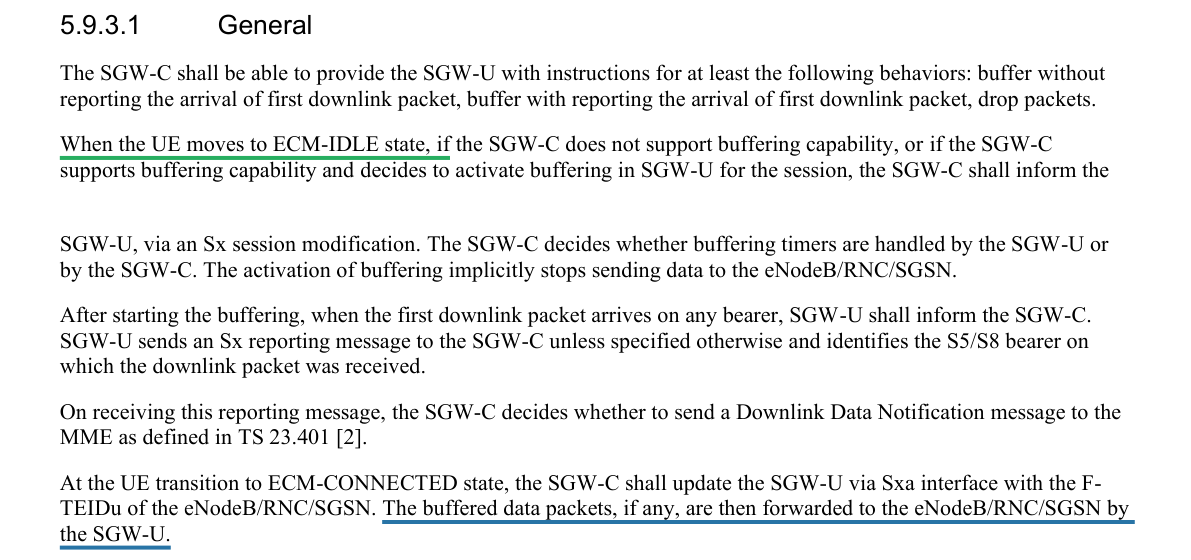


informing, by the control plane node (134), the user plane node (142) of information for receiving the downlink packet for the UE (110);
The SGW-C informs the SGW-U via an Sx session modification and provisions a BAR in the Sx session message; the BAR instructs the SGW-U how to buffer the downlink packet of the UE. When parameter D is handled by the SGW-U, the SGW-C also includes D in the same Sx session messages.


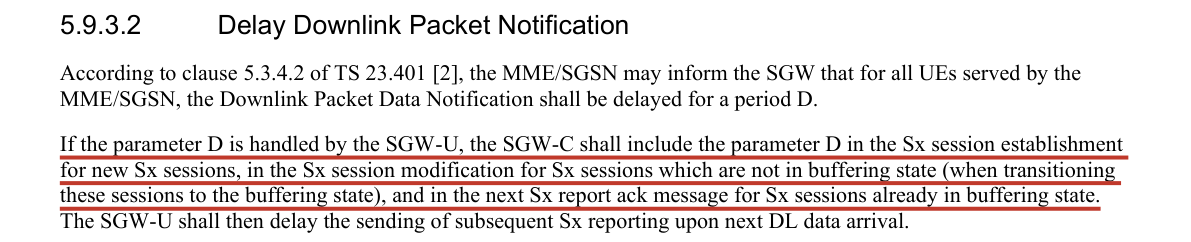

receiving and buffering, by the user plane node (142), the downlink packet for the UE (110);
The SGW-U buffers the downlink packet of the UE in idle mode: buffering by the SGW-U is mandatory, and after the buffering has started the SGW-U receives the first downlink packet arriving on a bearer. The clause names the SGW-U and the SGW-C as alternative places for buffering; the chart takes the SGW-U.

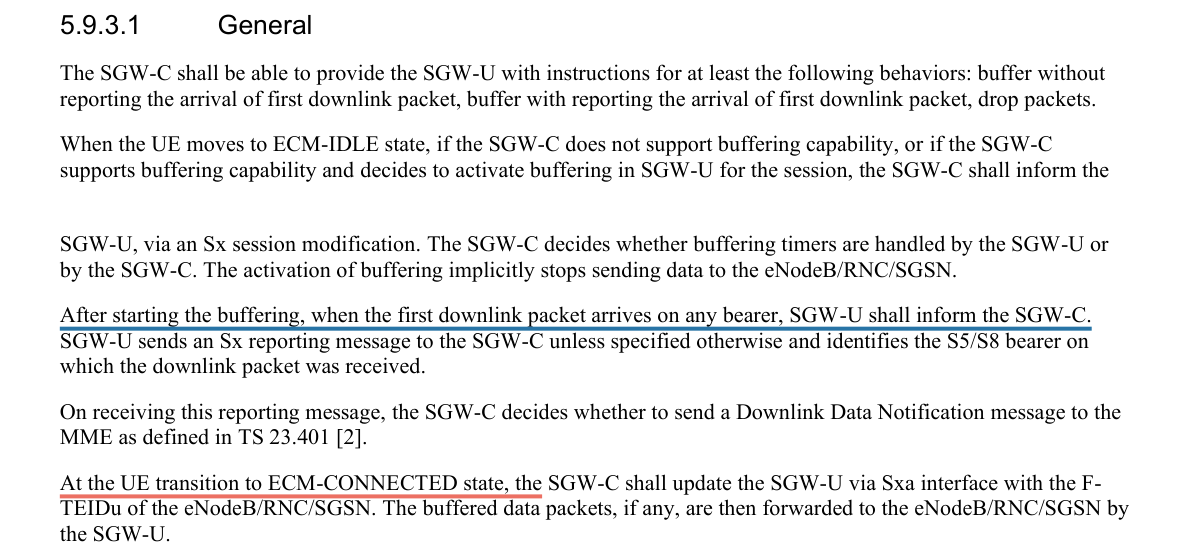
transmitting, by the user plane node (142), a notification message of a reception of the downlink packet to the control plane node (134); and
When the first downlink packet arrives, the SGW-U sends an Sx reporting message to the SGW-C, which then decides whether to send a Downlink Data Notification message to the MME.
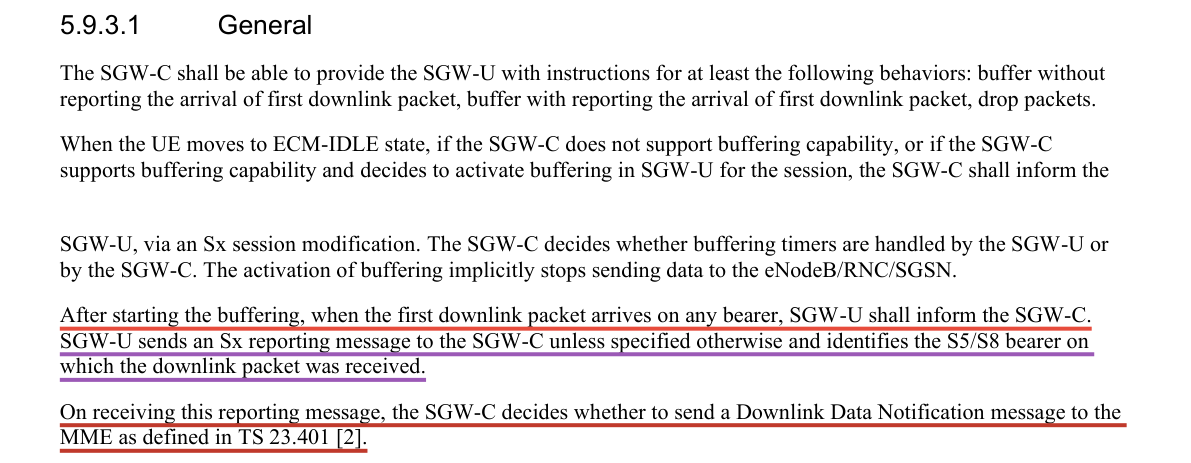
transmitting, by the user plane node (142), the buffered downlink packet to the UE (110) through a base station (120),
After the UE moves to the connected state, the SGW-C updates the SGW-U with the F-TEIDu of the eNodeB, and the SGW-U forwards the buffered downlink packet to it for the UE. The clause ends at the eNodeB; the relay on to the UE is not spelled out.



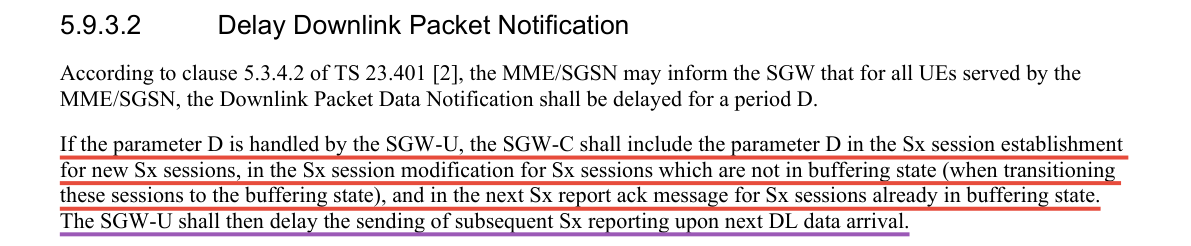
characterized in that the user plane node (142) delays the notification message of the reception of the downlink packet to the control plane node (134) until a preset buffering time elapses,
With parameter D handled by the SGW-U, the SGW-C includes D in the Sx session messages and the SGW-U delays its Sx reporting message on the next arrival of a downlink packet; the delay is the Downlink Data Notification Delay IE, which indicates the delay the UP function shall apply between receiving a downlink data packet and notifying the CP function. The delay is optional: it applies when the UP function indicates support of the Downlink Data Notification Delay parameter and D has been provided.



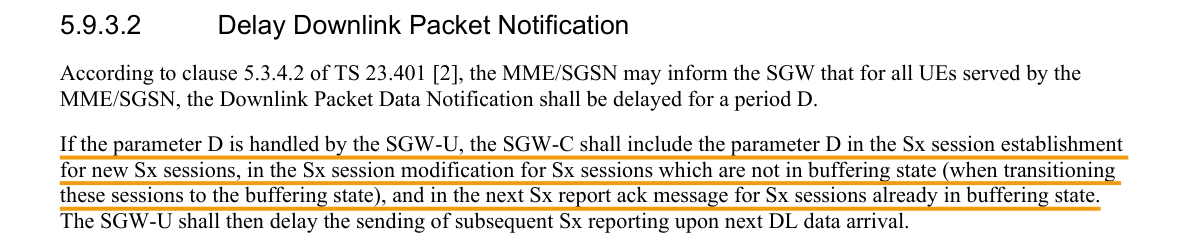
wherein the information includes the preset buffering time.
The BAR the CP function provisions lists the Downlink Data Notification Delay IE among its buffering parameters, and the SGW-C includes parameter D in the Sx session messages. The parameter is optional: it is carried when the UP function supports the Downlink Data Notification Delay parameter and D is provided.

Overall assessment
L1–L6 map to the standard.
References
- TS 23.214 — Architecture enhancements for control and user plane separation of EPC nodes; Stage 2
- TS 23.401 — General Packet Radio Service (GPRS) enhancements for Evolved Universal Terrestrial Radio Access Network (E-UTRAN) access
- TS 29.244 — Interface between the Control Plane and the User Plane Nodes; Stage 3
- EP3410774B1 — Method and gateway for transmitting downlink packet in function-separated core network (Google Patents)
this document is a technical essentiality assessment prepared for reference, comparing published patent documents against 3GPP standard specifications. It is not a legal determination or legal advice on the essentiality, validity or infringement of the patent. Before any material decision such as licensing or litigation, obtain a review by a qualified patent attorney or attorney at law.
Run it on your own patent
Enter a patent number and get the same chart for your claim. Your first report is free with a company email.
Get started