
EP2229744 Claim 1 vs 3GPP TS 36.322: Sample Claim Chart
The content of a report SEPPi generated, shown as delivered. Reports are written in English.
Bibliographic data
- Patent number
- EP2229744
- Title
- Method and arrangement in a wireless communication network
- Inventors
- Janne Peisa, Michael Meyer, Johan Torsner
- Priority date
- 2008-01-08
- Filing date
- 2008-01-08
- Assignee
- Telefonaktiebolaget LM Ericsson AB
- Standard assessed
- TS 36.322 E-UTRA RLC — polling by PDU count and byte count (§5.2.2.1) — Any 3GPP Rel-8 compliant UE / eNB
- Target release
- Rel-8 (TS 36.322 v8.8.0, TS 36.300 v8.12.0, TS 36.331 v8.21.0)
Claim 1 (independent)
Method in a first node for requesting a status report from a second node, the first node and the second node both being comprised within a wireless communication network, the status report comprising positive and/or negative acknowledgement of data sent from the first node to be received by the second node, wherein the method comprises the steps of: transmitting a sequence of data units or data unit segments to be received by the second node, the method further comprises the steps of: counting the number of transmitted data units and the number of transmitted data bytes of the transmitted data units, and, requesting a status report from the second node if the counted number of transmitted data units exceeds or equals a first predefined value or the counted number of transmitted data bytes of the transmitted data units exceeds or equals a second predefined value.
Standard under assessment
Rel-8 · TS 36.322 v8.8.0 · TS 36.300 v8.12.0 · TS 36.331 v8.21.0
Primary target: TS 36.322 (E-UTRA Radio Link Control), version 8.8.0 of Rel-8 — §5.2.2.1 (transmission of an AMD PDU), §7.1 (counters) and §7.4 (configurable parameters) — with the RRC configuration of the thresholds in TS 36.331 version 8.21.0, §6.3.2 (RLC-Config), and the network architecture in TS 36.300 version 8.12.0, §4. All extracts and screenshots are taken from Rel-8.
The chart follows one path of the polling procedure: the count-based trigger of §5.2.2.1, which compares the number of AMD PDUs and the number of data bytes sent since the last poll with the configured thresholds. The other poll triggers of that clause (both buffers empty, expiry of t-PollRetransmit) are not used. The first node is read as the UE and the second node as the eNB; the specification words the procedure for either end of the link.
The same counters and thresholds are worded in the NR specification TS 38.322, whose polling clause first appears in Rel-15. The UMTS specification TS 25.322 triggers a poll by PDU count and SDU count only, with no byte count. E-UTRA is charted because the technology entered the standard there first. The declaration recorded by ETSI names TS 38.322, which has no Rel-8 version.
The wording of TS 36.322 §4.2.1, §5.2.2.1 and §7.4 is different in Rel-19; every other cited clause reads the same word for word in Rel-19.
Claim chart
Matching colors mark corresponding elements between the claim and the standard. An underline in a screenshot marks the text the mapping rests on.
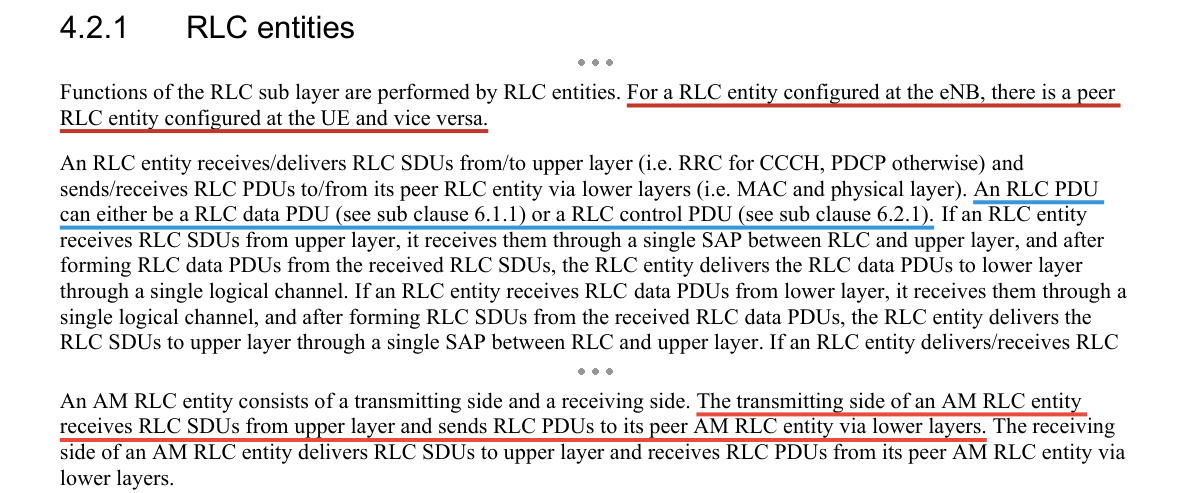
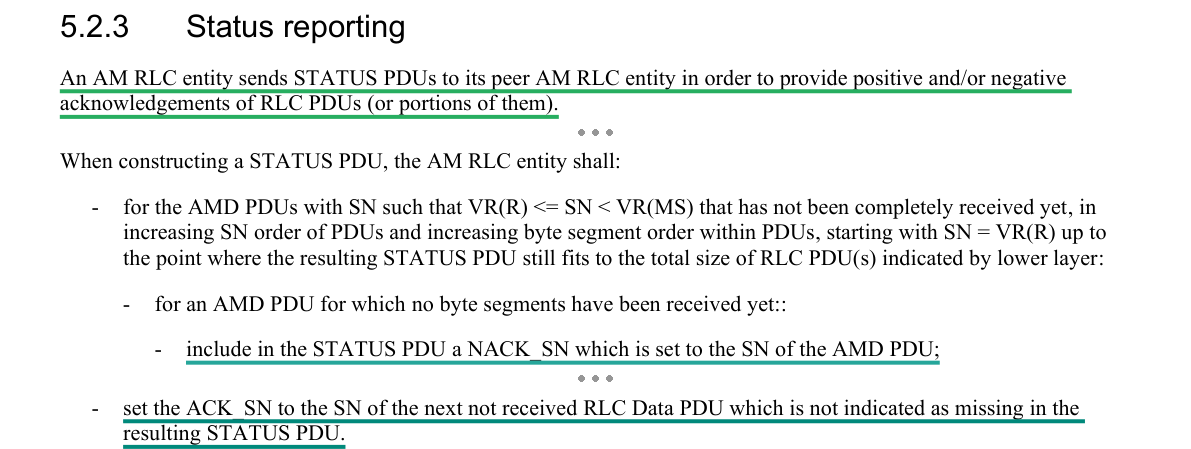
Method in a first node for requesting a status report from a second node, the first node and the second node both being comprised within a wireless communication network, the status report comprising positive and/or negative acknowledgement of data sent from the first node to be received by the second node, wherein the method comprises the steps of:
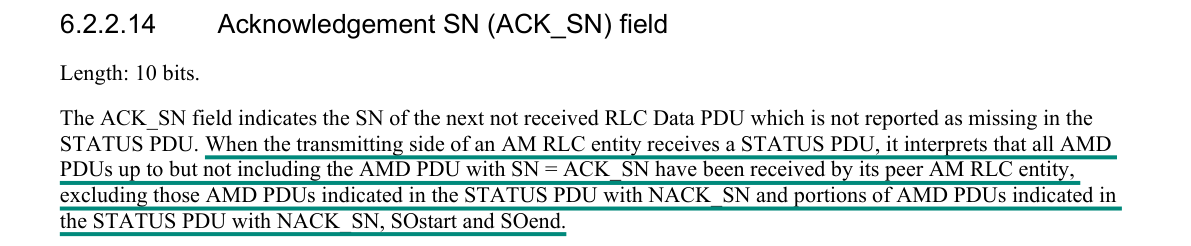
Context: the claimed method is the polling of acknowledged-mode RLC in E-UTRA. The transmitting side of an AM RLC entity in the UE is the first node and the peer AM RLC entity in the eNB is the second node, both within the E-UTRAN. The STATUS report provides positive acknowledgement (ACK_SN field) and/or negative acknowledgement (NACK_SN) of the RLC data PDUs the first node sent.






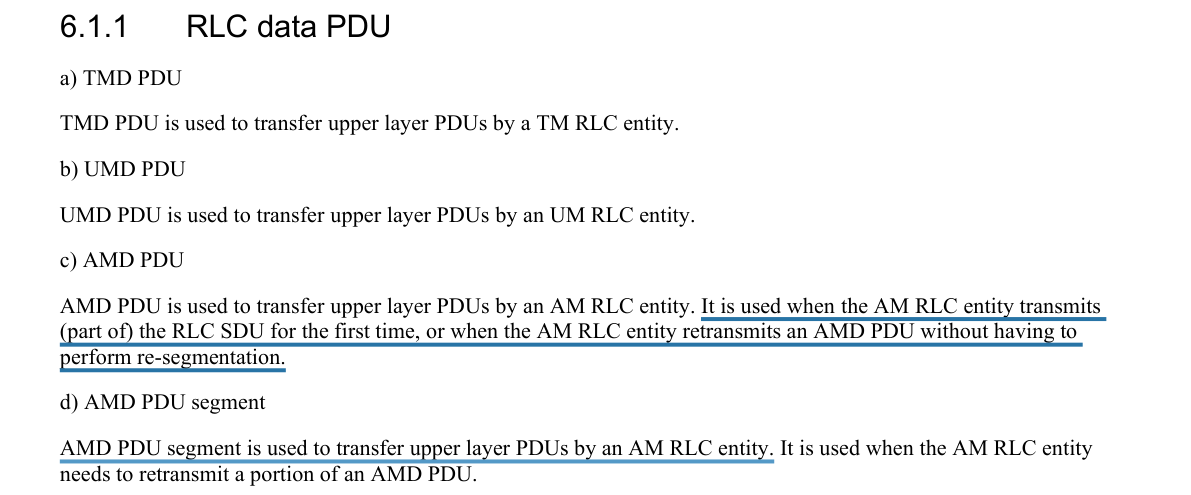
transmitting a sequence of data units or data unit segments to be received by the second node, the method further comprises the steps of:
The transmitting side delivers each new AMD PDU to lower layer for sending to the peer entity and, for a retransmitted portion, AMD PDU segments; the receiving side of the peer AM RLC entity receives them.




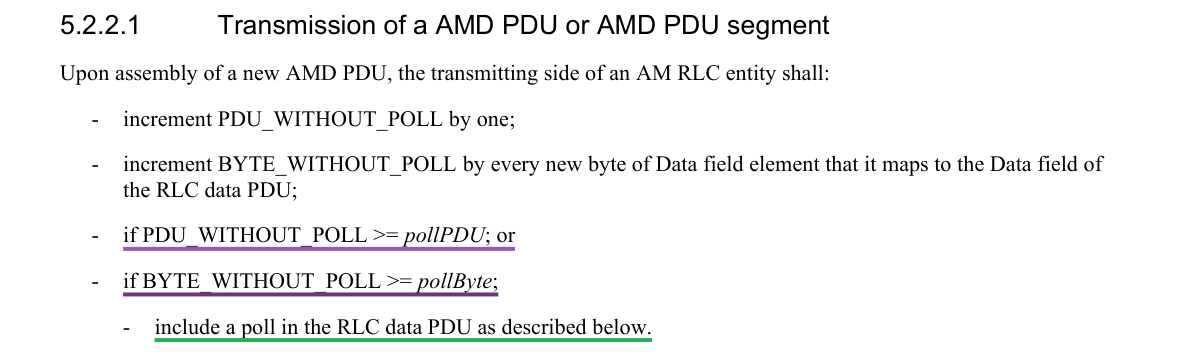
counting the number of transmitted data units and the number of transmitted data bytes of the transmitted data units,
Upon assembly of a new AMD PDU the transmitting side increments PDU_WITHOUT_POLL by one; the counter holds the number of AMD PDUs sent since the most recent poll bit was transmitted. It increments BYTE_WITHOUT_POLL by every new byte of Data field element mapped to the Data field; the counter holds the number of data bytes sent since the most recent poll bit was transmitted.


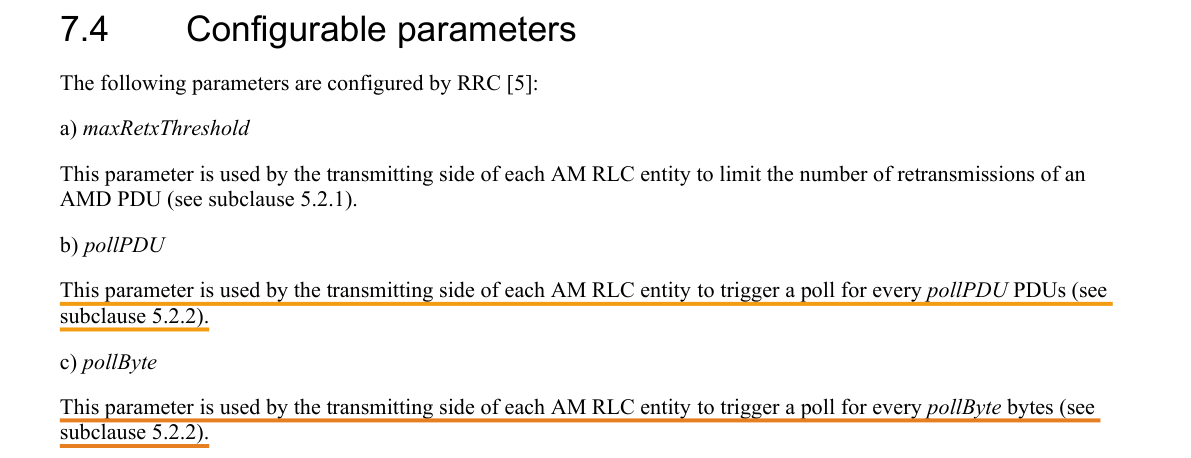
requesting a status report from the second node if the counted number of transmitted data units exceeds or equals a first predefined value or the counted number of transmitted data bytes of the transmitted data units exceeds or equals a second predefined value.
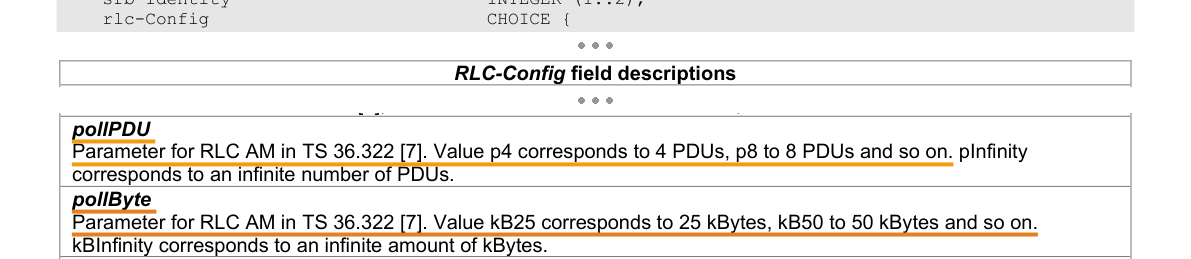
When either condition is met the transmitting side includes a poll in the RLC data PDU: the P field requests a STATUS report from the peer AM RLC entity. The condition is met if PDU_WITHOUT_POLL reaches the pollPDU Parameter, or if BYTE_WITHOUT_POLL reaches the pollByte Parameter; both are configured by RRC.


Overall assessment
L1–L3 map to the standard.
References
- TS 36.322 — Evolved Universal Terrestrial Radio Access (E-UTRA); Radio Link Control (RLC) protocol specification
- TS 36.331 — Evolved Universal Terrestrial Radio Access (E-UTRA); Radio Resource Control (RRC); Protocol specification
- TS 36.300 — Evolved Universal Terrestrial Radio Access (E-UTRA) and Evolved Universal Terrestrial Radio Access Network (E-UTRAN); Overall description; Stage 2
- EP2229744 — Method and arrangement in a wireless communication network (Google Patents)
this document is a technical essentiality assessment prepared for reference, comparing published patent documents against 3GPP standard specifications. It is not a legal determination or legal advice on the essentiality, validity or infringement of the patent. Before any material decision such as licensing or litigation, obtain a review by a qualified patent attorney or attorney at law.
Run it on your own patent
Enter a patent number and get the same chart for your claim. Your first report is free with a company email.
Get started