
US8971279B2 청구항 1 · 3GPP TS 36.321 대조 샘플 클레임 차트
SEPPi가 생성한 리포트의 내용을 그대로 옮긴 것입니다. 리포트 본문은 영문으로 제공됩니다.
서지 정보
- 특허 번호
- US8971279B2
- 발명의 명칭
- Method and apparatus for indicating deactivation of semi-persistent scheduling
- 발명자
- Dong Youn Seo, Ki Jun Kim, Dae Won Lee, Young Woo Yun, Joon Kui Ahn
- 최우선일
- 2008-11-13
- 출원일
- 2013-03-08
- 권리자
- Sisvel SpA
- 대조 표준
- 3GPP E-UTRA Rel-8 — PDCCH validation for semi-persistent scheduling (TS 36.213 §9.2) and UL grant reception (TS 36.321 §5.4.1) — Any 3GPP Rel-8 compliant UE
- 대상 릴리즈
- Rel-8 (TS 36.321 v8.12.0, TS 36.300 v8.12.0, TS 36.213 v8.8.0, TS 36.331 v8.21.0, TS 36.211 v8.9.0, TS 36.212 v8.8.0)
청구항 1 (독립항)
A method for deactivating Semi-Persistent Scheduling (SPS) transmission in a wireless mobile communication system, the method comprising: performing, by a User Equipment (UE), a SPS transmission at an interval of a subframe period configured by a radio resource control (RRC) signal; receiving, by the UE, a Physical Downlink Control Channel (PDCCH) signal with a Radio Network Temporary Identifier (RNTI), wherein the PDCCH signal includes a first field related to a resource allocation; and performing a procedure for deactivating the SPS transmission if the PDCCH signal satisfies conditions for SPS deactivation, wherein the conditions for SPS deactivation include: the RNTI is a SPS Cell RNTI (SPS C-RNTI); and the first field is entirely filled with ‘1’.
대조 대상 표준
Rel-8 · TS 36.321 v8.12.0 · TS 36.300 v8.12.0 · TS 36.213 v8.8.0 · TS 36.331 v8.21.0 · TS 36.211 v8.9.0 · TS 36.212 v8.8.0
Primary target: 3GPP E-UTRA (LTE) Release 8 — TS 36.213 v8.8.0 §9.2 (PDCCH validation for semi-persistent scheduling) and TS 36.321 v8.12.0 §5.4.1 (UL grant reception), supported by TS 36.321 §5.10.2 and §7.1, TS 36.331 §5.3.10.5 and §6.3.2, TS 36.212 §5.3.3.1.1, TS 36.211 §6.8.1 and TS 36.300 §8.1 and §11.1.2. Release. Release 8 is the earliest release of these specifications available at the date of analysis, and every clause cited is present there, so Release 8 is the release in which the claimed technology is charted. The Release 8 documents are cited at their last version.
Branch of the standard followed. All rows are mapped along one branch: the release of an uplink semi-persistent grant by a PDCCH with DCI format 0 addressed with the Semi-Persistent Scheduling C-RNTI, for a single uplink SPS configuration. Release 8 specifies the PDCCH variant only.
Other specification family. The NR physical layer procedures specification (TS 38.213, first present in Release 15) also contains a PDCCH validation clause for semi-persistent scheduling and configured grants; they are not charted here because the claimed technology entered the standard in LTE first.
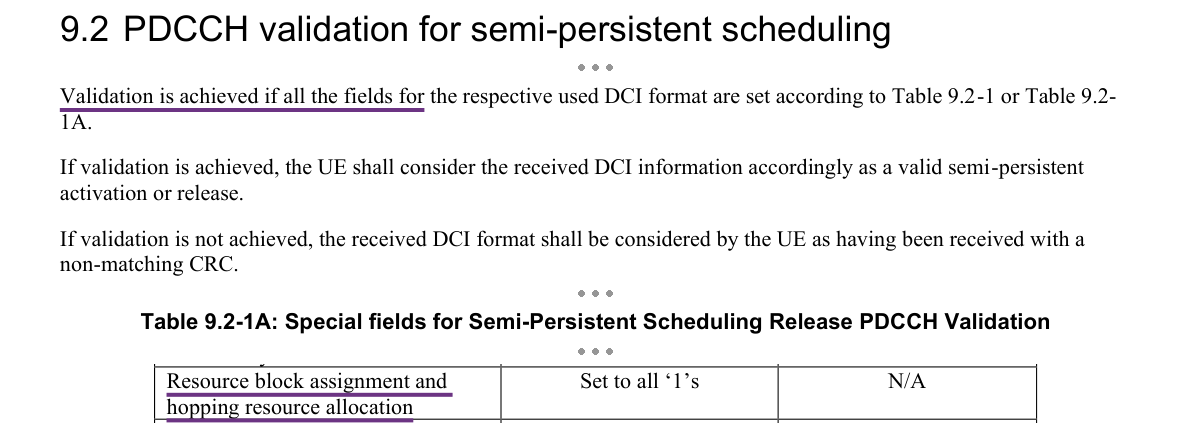
Reading of the release table. In the Release 8 page of TS 36.213 §9.2 the release-validation table gives the value 'Set to all ‘1’s' in the row 'Resource block assignment and hopping resource allocation'. The text of that cell cannot be read from the document text, so the value is shown in the screenshot of row L6 and the underline is placed on the row label.
클레임 차트
같은 색상은 청구항과 표준에서 대응되는 구성을 나타냅니다. 원문 발췌의 밑줄은 대응의 근거가 된 문언입니다.
A method for deactivating Semi-Persistent Scheduling (SPS) transmission in a wireless mobile communication system, the method comprising:
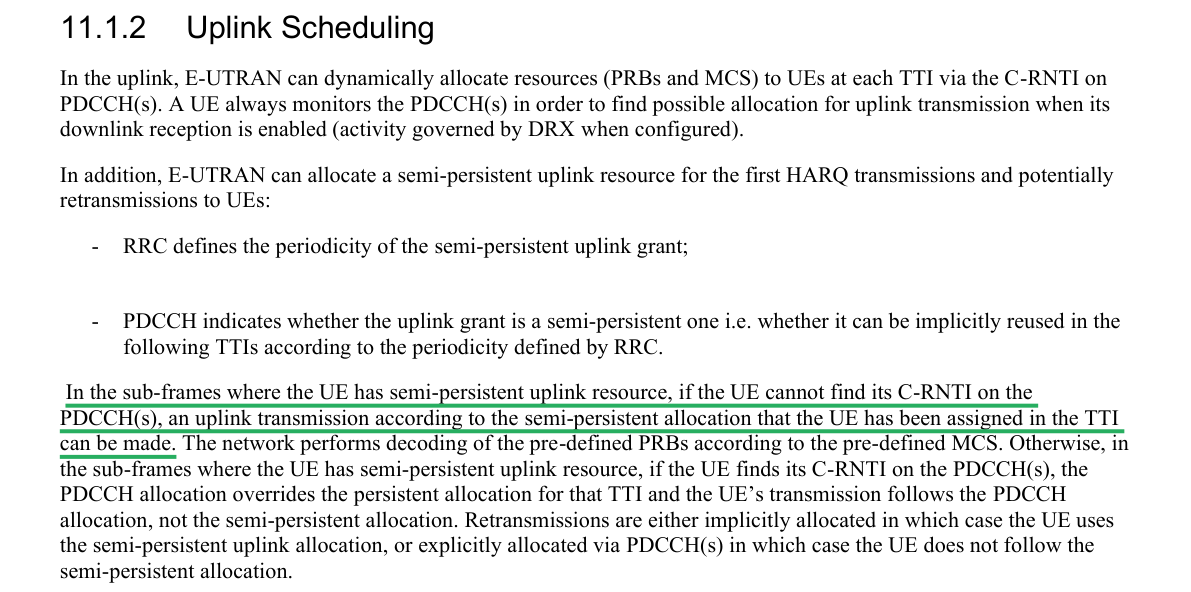
Context: TS 36.300 describes the setting of the claim — E-UTRAN can allocate a semi-persistent uplink resource, on which the UE makes the uplink transmission according to the semi-persistent allocation that the claim goes on to perform and deactivate.

performing, by a User Equipment (UE), a SPS transmission at an interval of a subframe period configured by a radio resource control (RRC) signal;
The UE performs the uplink transmission according to the semi-persistent allocation by delivering the configured uplink grant to the HARQ entity (TS 36.321 §5.4.1); once the grant is configured it recurs in each subframe given by semiPersistSchedIntervalUL (TS 36.321 §5.10.2). That interval, in sub-frames, is a field of the SPS-Config IE, which RRC uses to specify the semi-persistent scheduling configuration (TS 36.331 §6.3.2). The configuration is optional: the behaviour holds when the UE is configured with uplink semi-persistent scheduling.
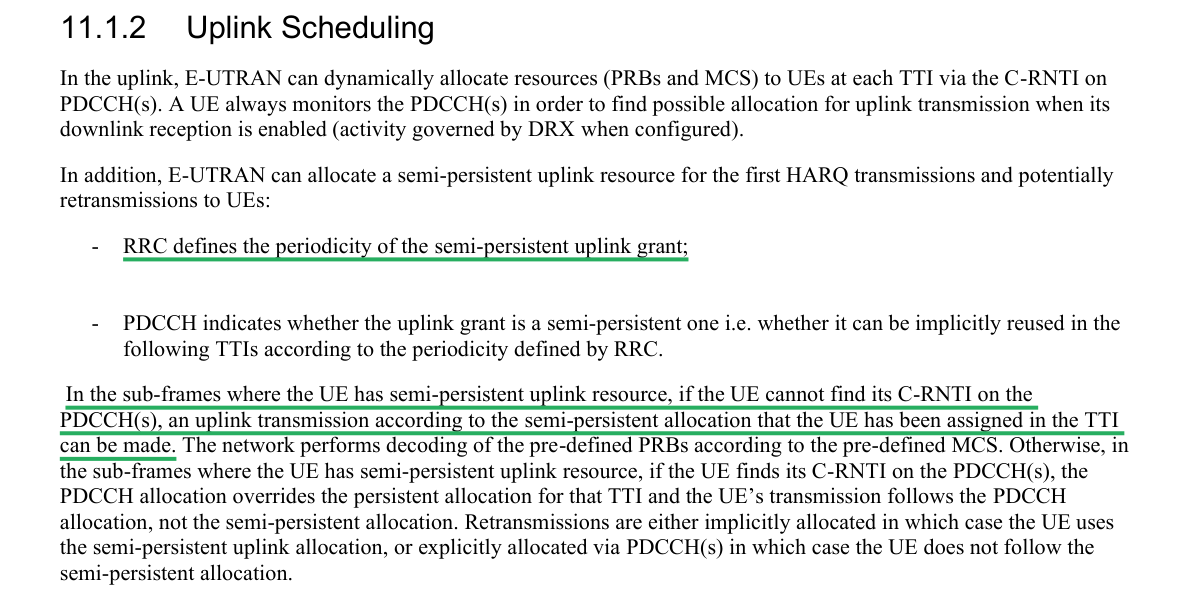
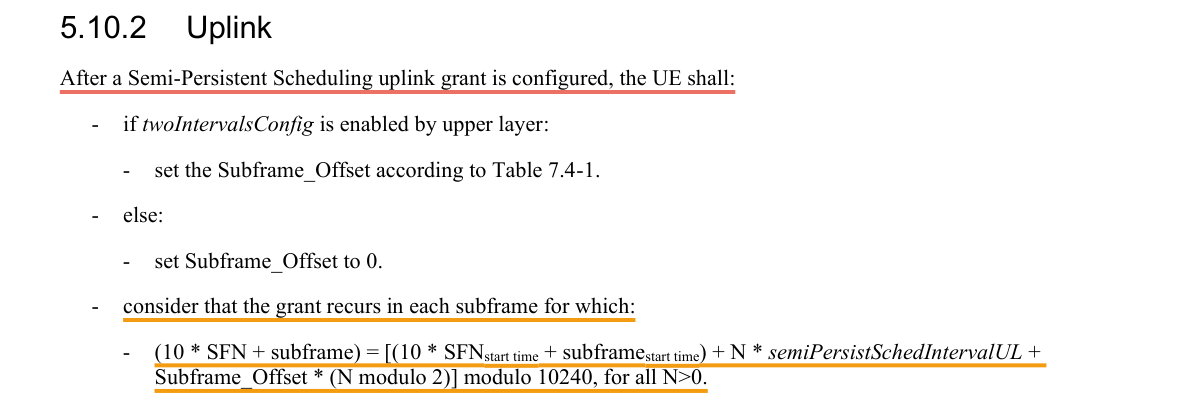
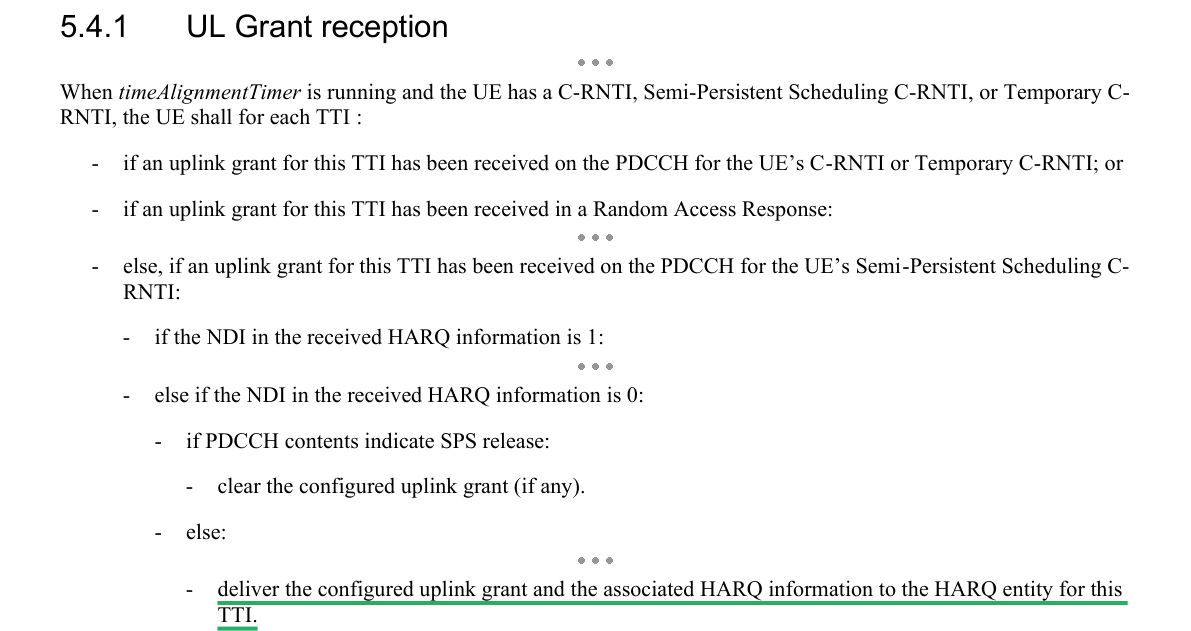



receiving, by the UE, a Physical Downlink Control Channel (PDCCH) signal with a Radio Network Temporary Identifier (RNTI),
The UE receives the Semi-Persistent Scheduling assignment PDCCH: it handles an uplink grant 'received on the PDCCH for the UE’s Semi-Persistent Scheduling C-RNTI' (TS 36.321 §5.4.1) and validates that PDCCH (TS 36.213 §9.2), the PDCCH carrying scheduling assignments and other control information (TS 36.211 §6.8.1). The PDCCH is addressed with an RNTI, one of the E-UTRAN related UE identities (TS 36.321 §7.1, TS 36.300 §8.1).



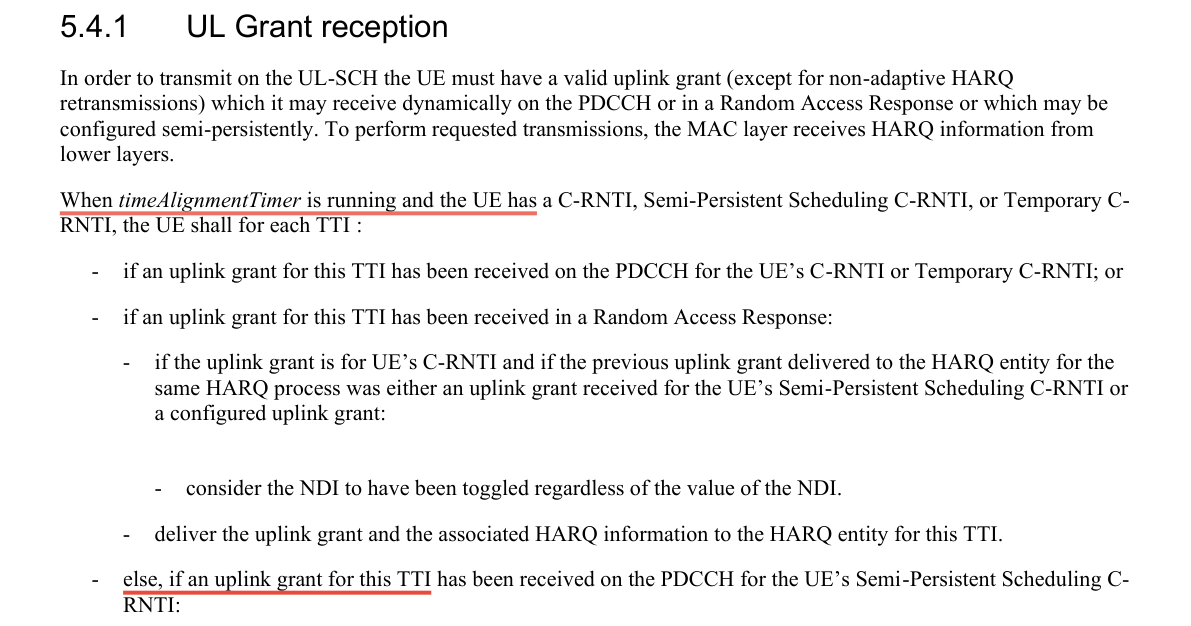

wherein the PDCCH signal includes a first field related to a resource allocation; and
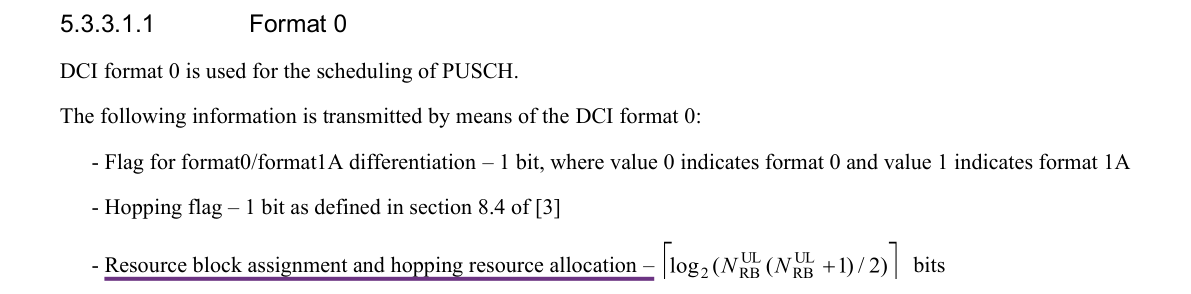
The Semi-Persistent Scheduling assignment PDCCH carries DCI format 0, which transmits the Resource block assignment and hopping resource allocation field (TS 36.212 §5.3.3.1.1); TS 36.213 §8.1 ties the resource allocation to the 'corresponding PDCCH with DCI format 0'.

performing a procedure for deactivating the SPS transmission if the PDCCH signal satisfies conditions for SPS deactivation,
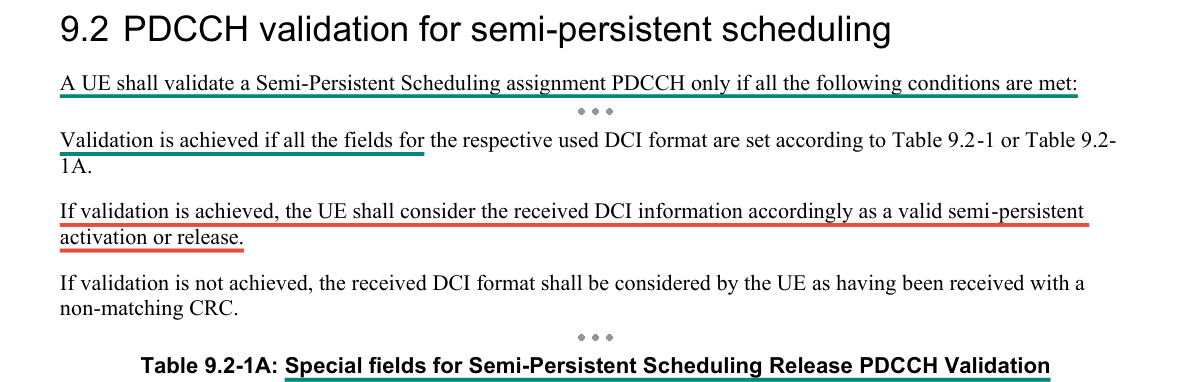
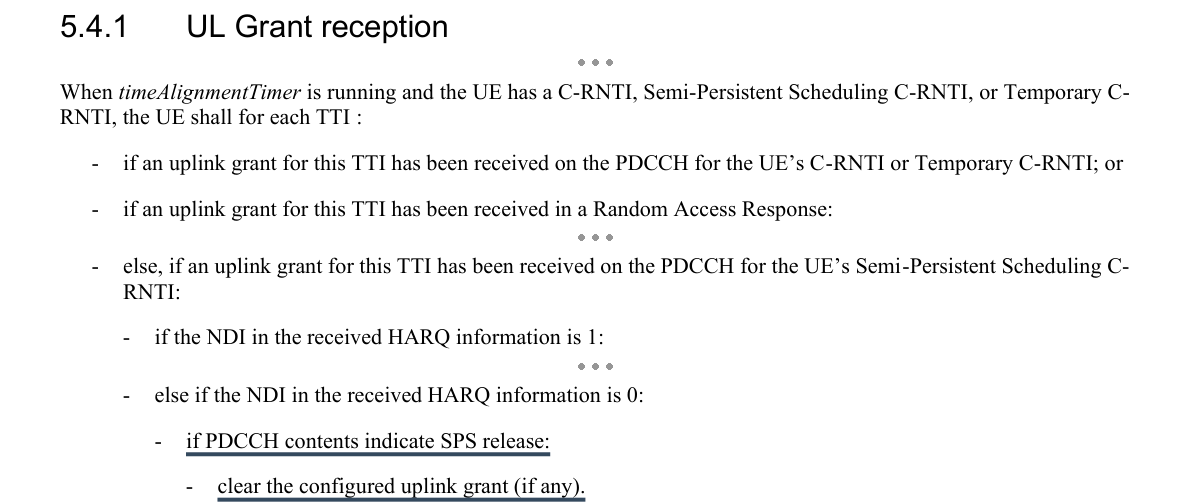
If the PDCCH contents indicate SPS release, the UE clears the configured uplink grant (TS 36.321 §5.4.1): the SPS release that deactivates the uplink transmission according to the semi-persistent allocation. Whether the received Semi-Persistent Scheduling assignment PDCCH is such a release is decided by the Semi-Persistent Scheduling Release PDCCH Validation of TS 36.213 §9.2: the UE validates the PDCCH only if all the listed conditions are met, and the fields are set as the release table requires. L5 and L6 state two of these conditions.
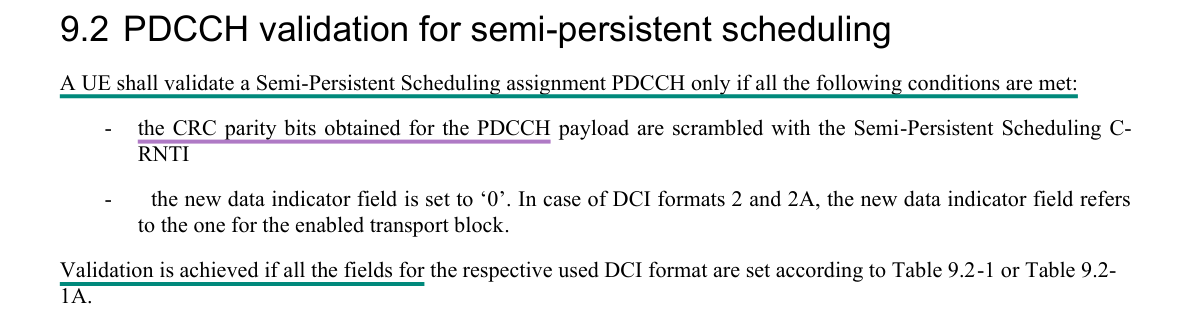
wherein the conditions for SPS deactivation include: the RNTI is a SPS Cell RNTI (SPS C-RNTI); and
One condition of the Semi-Persistent Scheduling Release PDCCH Validation is that the CRC parity bits of the PDCCH payload are scrambled with the Semi-Persistent Scheduling C-RNTI (TS 36.213 §9.2), the identity TS 36.300 §8.1 defines for semi-persistent scheduling. The RNTI with which the PDCCH is received is thereby that identity (TS 36.321 §7.1).


the first field is entirely filled with ‘1’.
The other condition: in the release validation the row of the Resource block assignment and hopping resource allocation field of DCI format 0 reads 'Set to all ‘1’s' (value shown in the screenshot, underline on the row label); the validation is achieved when all fields of the DCI format are set according to the table (TS 36.213 §9.2).
종합
L1–L6 map to the standard along the uplink release path of semi-persistent scheduling: the Semi-Persistent Scheduling C-RNTI and the all-ones resource allocation field validate a PDCCH as an SPS release.
참고 문헌
- TS 36.211 — E-UTRA; Physical channels and modulation
- TS 36.212 — E-UTRA; Multiplexing and channel coding
- TS 36.213 — E-UTRA; Physical layer procedures
- TS 36.300 — E-UTRA and E-UTRAN; Overall description; Stage 2
- TS 36.321 — E-UTRA; Medium Access Control (MAC) protocol specification
- TS 36.331 — E-UTRA; Radio Resource Control (RRC); Protocol specification
- US8971279B2 — Method and apparatus for indicating deactivation of semi-persistent scheduling (Google Patents)
this document is a technical essentiality assessment prepared for reference, comparing published patent documents against 3GPP standard specifications. It is not a legal determination or legal advice on the essentiality, validity or infringement of the patent. Before any material decision such as licensing or litigation, obtain a review by a qualified patent attorney or attorney at law.
내 특허로 만들어 보기
특허 번호를 입력하면 같은 형식의 차트를 받습니다. 회사 이메일로 가입하면 첫 리포트 1건은 무료입니다.
시작하기