
EP3996459B1 청구항 1 · 3GPP TS 37.213 대조 샘플 클레임 차트
SEPPi가 생성한 리포트의 내용을 그대로 옮긴 것입니다. 리포트 본문은 영문으로 제공됩니다.
서지 정보
- 특허 번호
- EP3996459B1
- 발명의 명칭
- Channel access method for performing transmission in unlicensed band, and device using same
- 발명자
- Minseok Noh, Kyungjun CHOI, Jinsam Kwak
- 최우선일
- 2019-08-06
- 출원일
- 2020-08-06
- 권리자
- Wilus Institute of Standards and Technology Inc
- 대조 표준
- 3GPP NR channel access in shared spectrum (unlicensed band) — TS 37.213 §4.2.1.0.1 and the Type 2A / Type 2B UL channel access procedures — Any 3GPP Rel-16 compliant UE
- 대상 릴리즈
- Rel-16 (TS 37.213 v16.14.0, TS 38.300 v16.22.0, TS 38.212 v16.15.0, TS 38.321 v16.22.0)
청구항 1 (독립항)
A user equipment, UE (100), for use in a 3rd generation partnership project new radio, 3GPP NR,-based wireless communication system supporting operations on an unlicensed band, the UE comprising: a communication module (120); and a processor (110) controlling the communication module (120), wherein the processor (110) is configured to carry out a method comprising: receiving at least one uplink, UL, grant for scheduling a plurality of consecutive UL transmissions on the unlicensed band, wherein the at least one UL grant indicates a channel access type as one of at least: - a first channel access type based on a random back-off, and - a second channel access type based on a fixed sensing duration only, the fixed sensing duration having one of various lengths including 16µs and 25µs; characterized by, based on the indicated channel access type, attempting a first channel access to perform an UL transmission, which is not a last UL transmission, among the plurality of consecutive UL transmissions on the unlicensed band; and based on 1) the first channel access corresponding to the second channel access type with a fixed sensing duration of 16µs, and 2) the first channel access being failed, attempting a second channel access to perform a next UL transmission among the plurality of consecutive UL transmissions, according to the second channel access type with a fixed sensing duration of 25µs.
대조 대상 표준
Rel-16 · TS 37.213 v16.14.0 · TS 38.300 v16.22.0 · TS 38.212 v16.15.0 · TS 38.321 v16.22.0
Primary target: 3GPP NR operation with shared spectrum channel access, Rel-16 — TS 37.213 (physical layer procedures for shared spectrum channel access) §4.2.1.0.1 for consecutive UL transmissions and §4.2.1.2.1 / §4.2.1.2.2 for the Type 2A and Type 2B UL channel access procedures, with the UL grant channel access field in TS 38.212 §7.3.1.1.2, the stage-2 description in TS 38.300 §1 and §5.6.1, and the reception of a UL grant in TS 38.321 §5.4.1.
Release: Rel-16 is the release in which NR channel access in unlicensed spectrum entered the standard (CR 0005 to TS 37.213, RP-192636, RAN#86, December 2019); the rule for consecutive UL transmissions and the Type 2A and Type 2B definitions are absent from the Rel-15 edition of TS 37.213 and present in Rel-16.
Branch: every row is mapped on one branch of the rule for consecutive UL transmissions — the branch that applies when the access that failed followed the Type 2B UL channel access procedure (16 µs), which the claim's own condition selects; the claim's first and second channel access types are the alternatives of the indicated type. The sentences cited are identical in Rel-19, except the field description in TS 38.212 §7.3.1.1.2, which was extended in later releases to cover frequency range operation; the Rel-16 wording is cited.
클레임 차트
같은 색상은 청구항과 표준에서 대응되는 구성을 나타냅니다. 원문 발췌의 밑줄은 대응의 근거가 된 문언입니다.
A user equipment, UE (100), for use in a 3rd generation partnership project new radio, 3GPP NR,-based wireless communication system supporting operations on an unlicensed band, the UE comprising:
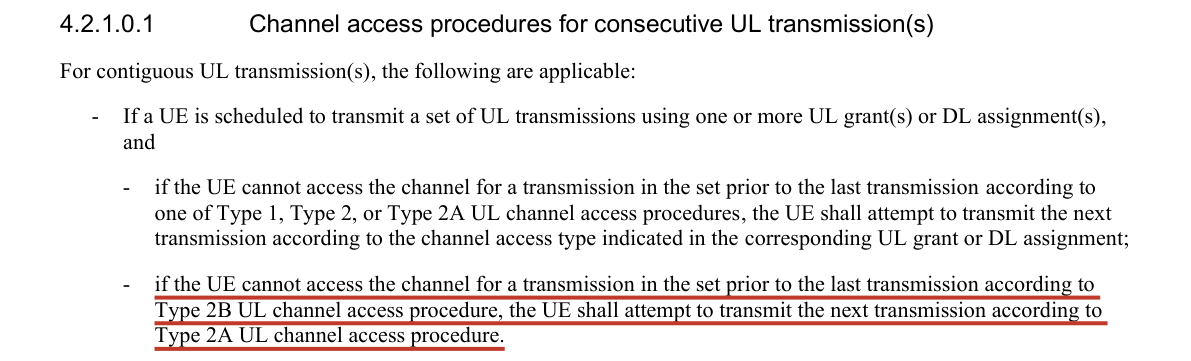
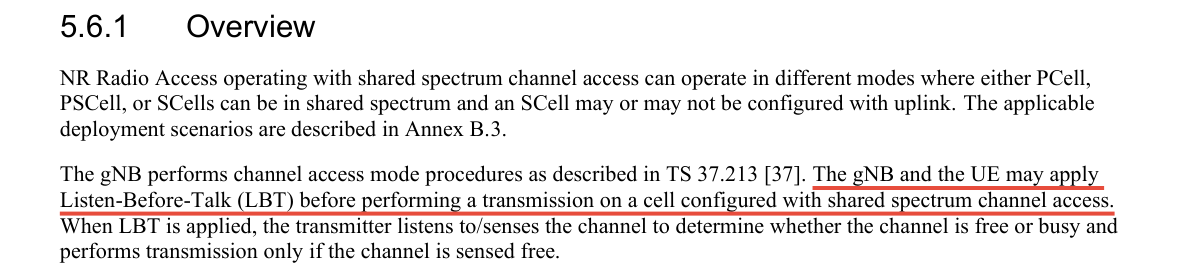
Context: the claimed UE is the device that, when its channel access fails, attempts the next transmission (TS 37.213 §4.2.1.0.1). It sits in the NG-RAN with the NR radio interface (TS 38.300 §1), where NR operates with shared spectrum channel access (TS 38.300 §5.6.1).


a communication module (120); and
Generic implementation component — not assessed against the standard. What the apparatus does with it is assessed in the rows that state it.
a processor (110) controlling the communication module (120),
Generic implementation component — not assessed against the standard. What the apparatus does with it is assessed in the rows that state it.
wherein the processor (110) is configured to carry out a method comprising: receiving at least one uplink, UL, grant for scheduling a plurality of consecutive UL transmissions on the unlicensed band,
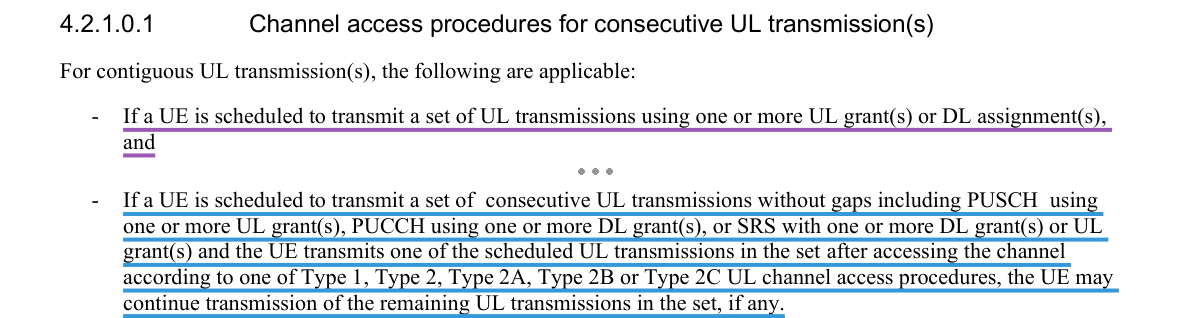
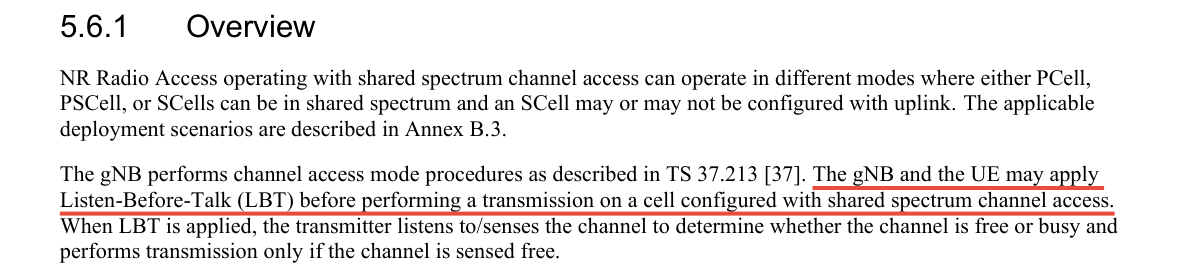
The UE is scheduled to transmit a set of consecutive UL transmissions using one or more UL grant(s) (TS 37.213 §4.2.1.0.1); an uplink grant is received dynamically on the PDCCH (TS 38.321 §5.4.1), on a cell with shared spectrum channel access, where the gNB and the UE may apply Listen-Before-Talk (TS 38.300 §5.6.1).

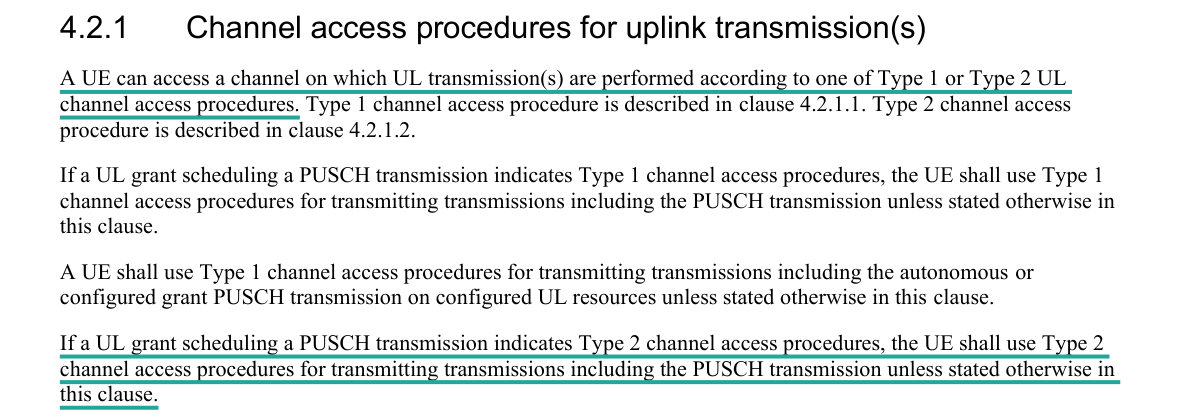
wherein the at least one UL grant indicates a channel access type as one of at least: - a first channel access type based on a random back-off, and - a second channel access type based on a fixed sensing duration only, the fixed sensing duration having one of various lengths including 16µs and 25µs;
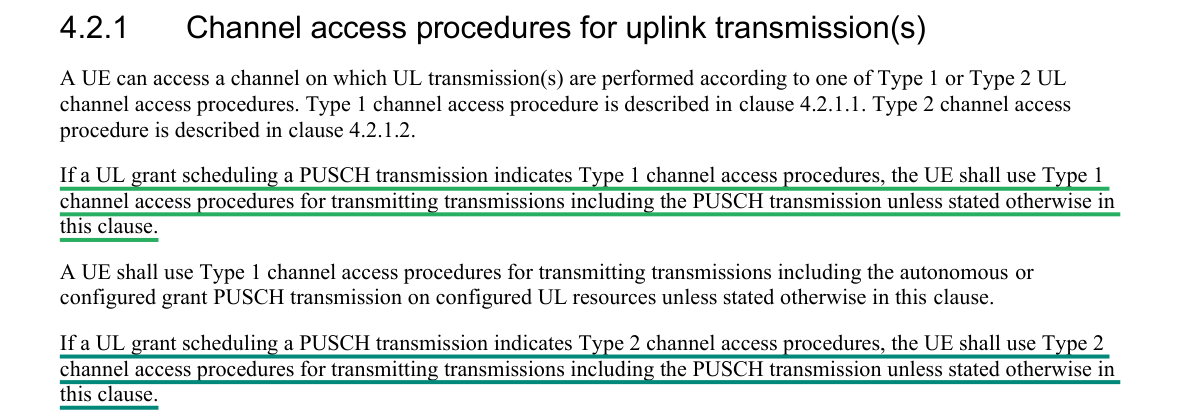
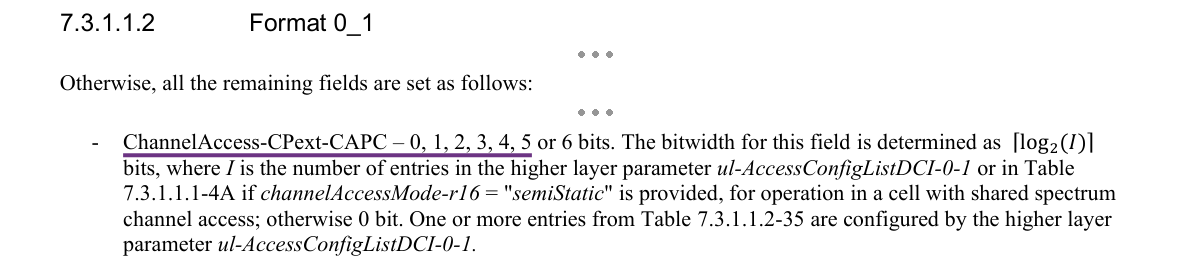
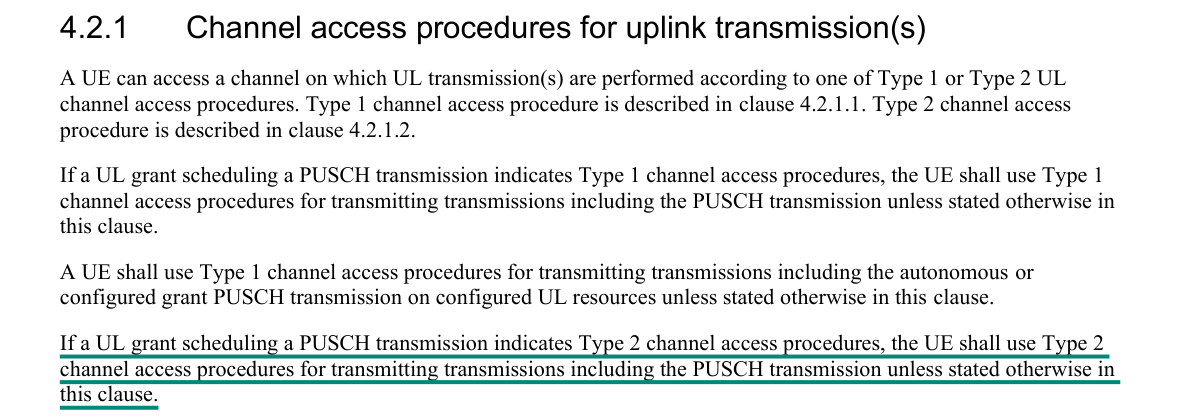
A UL grant indicates the access type: the gNB may indicate Type 2 channel access procedures in the DCI of a UL grant (TS 37.213 §4.2.1.0.3), and the grant carries the ChannelAccess-CPext-CAPC field (TS 38.212 §7.3.1.1.2). The first type is Type 1 channel access procedures, whose sensing duration is random (TS 37.213 §4.2.1 and §4.2.1.1); the second is Type 2 channel access procedures, whose sensing duration is deterministic (TS 37.213 §4.2.1 and §4.2.1.2), with the lengths T_f=16μs (Type 2B, TS 37.213 §4.2.1.2.2) and sensing interval T_short_ul=25μs (Type 2A, TS 37.213 §4.2.1.2.1). The field exists for operation in a cell with shared spectrum channel access and is 0 bit otherwise.





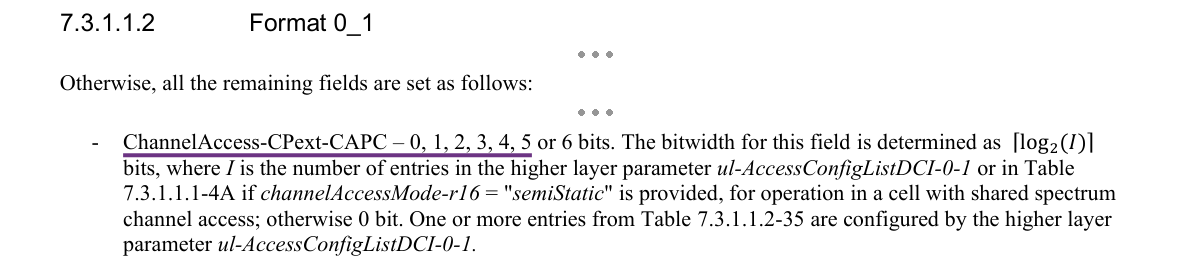
characterized by, based on the indicated channel access type, attempting a first channel access to perform an UL transmission, which is not a last UL transmission, among the plurality of consecutive UL transmissions on the unlicensed band; and
Based on the type the grant indicates (ChannelAccess-CPext-CAPC), the UE accesses the channel by the indicated UL channel access procedure — if a UL grant indicates Type 2 channel access procedures, the UE shall use them (TS 37.213 §4.2.1) — for a transmission in the set prior to the last transmission of the set of UL transmissions scheduled by the grant(s) (TS 37.213 §4.2.1.0.1), on shared spectrum where LBT may apply (TS 38.300 §5.6.1).
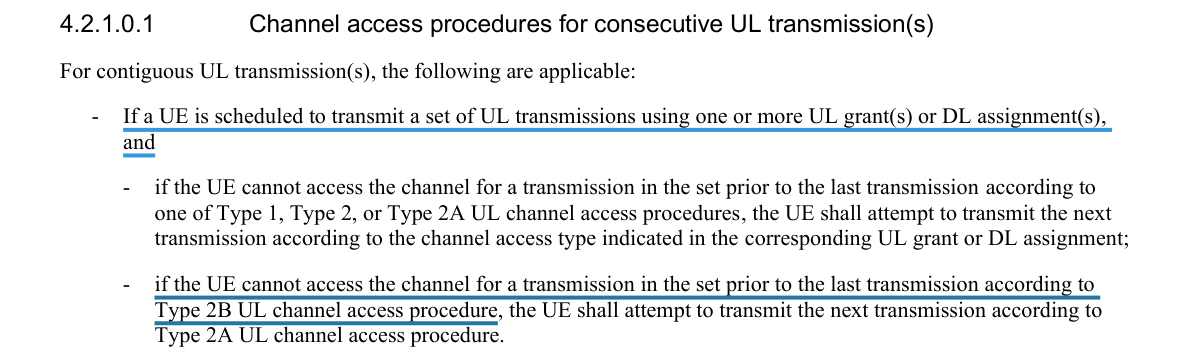
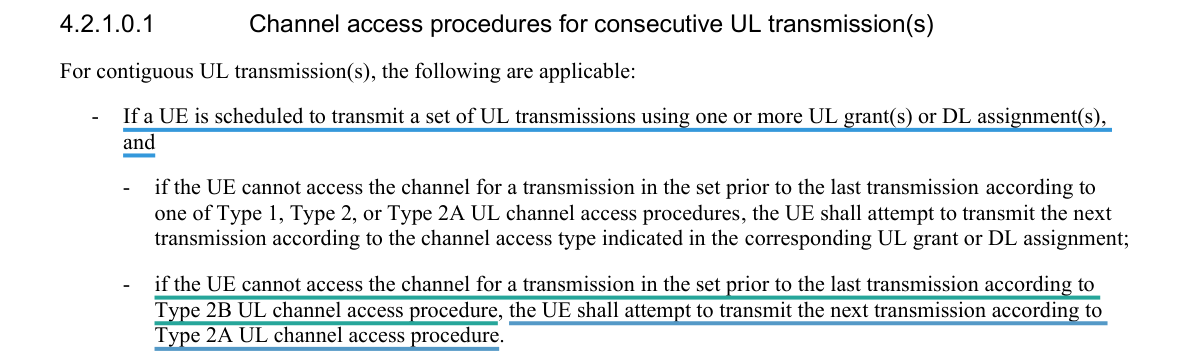
based on 1) the first channel access corresponding to the second channel access type with a fixed sensing duration of 16µs, and 2) the first channel access being failed, attempting a second channel access to perform a next UL transmission among the plurality of consecutive UL transmissions, according to the second channel access type with a fixed sensing duration of 25µs.
If the UE cannot access the channel for a transmission in the set prior to the last transmission according to Type 2B UL channel access procedure — the UL channel access procedure of the first access, a kind of Type 2 channel access procedures whose sensing lasts T_f=16μs — the UE shall attempt to transmit the next transmission according to Type 2A UL channel access procedure, which senses for the sensing interval T_short_ul=25μs (TS 37.213 §4.2.1.0.1, §4.2.1.2.1 and §4.2.1.2.2); the transmissions belong to the set of UL transmissions scheduled by the UL grant(s).


종합
L3–L6 map to the standard.
참고 문헌
- TS 37.213 — Physical layer procedures for shared spectrum channel access
- TS 38.212 — NR; Multiplexing and channel coding
- TS 38.300 — NR; NR and NG-RAN Overall Description; Stage 2
- TS 38.321 — NR; Medium Access Control (MAC) protocol specification
- EP3996459B1 — Channel access method for performing transmission in unlicensed band, and device using same (Google Patents)
this document is a technical essentiality assessment prepared for reference, comparing published patent documents against 3GPP standard specifications. It is not a legal determination or legal advice on the essentiality, validity or infringement of the patent. Before any material decision such as licensing or litigation, obtain a review by a qualified patent attorney or attorney at law.
내 특허로 만들어 보기
특허 번호를 입력하면 같은 형식의 차트를 받습니다. 회사 이메일로 가입하면 첫 리포트 1건은 무료입니다.
시작하기