
EP3355537 청구항 1 · 3GPP TS 25.321 대조 샘플 클레임 차트
SEPPi가 생성한 리포트의 내용을 그대로 옮긴 것입니다. 리포트 본문은 영문으로 제공됩니다.
서지 정보
- 특허 번호
- EP3355537
- 발명의 명칭
- MAC multiplexing and TFC selection procedure for enhanced uplink
- 발명자
- Stephen E. Terry
- 최우선일
- 2005-04-29
- 출원일
- 2005-04-29
- 권리자
- InterDigital Technology Corp
- 대조 표준
- UMTS enhanced uplink — MAC E-TFC selection (TS 25.321 §11.8.1.4), with TS 25.319 and TS 25.133 — Any 3GPP Rel-8 compliant UMTS FDD UE with an E-DCH transport channel
- 대상 릴리즈
- Rel-8 (TS 25.321 v8.17.0, TS 25.319 v8.12.0, TS 25.133 v8.20.0)
청구항 1 (독립항)
1A A wireless transmit/receive unit, WTRU, comprising: 1B means for receiving at least one serving grant and at least one non-scheduled grant, 1C wherein the at least one serving grant is a grant for scheduled data transmission 1D and the at least one non-scheduled grant is a grant for non-scheduled data transmission, characterized by: 1E means for determining supported enhanced dedicated channel transport format combinations, E- TFCs, within a E- TFC set, E-TFCS, based on a remaining transmit power for enhanced uplink, EU, transmission; and 1F means for limiting medium access control for dedicated channel, MAC-d, flow data multiplexed into a medium access control for enhanced uplink, MAC-e, protocol data unit, PDU, to a largest E-TFC size that is smaller than a size of MAC-d flow data allowed by the received serving and non-scheduled grants and available for transmission.
대조 대상 표준
Rel-8 · TS 25.321 v8.17.0 · TS 25.319 v8.12.0 · TS 25.133 v8.20.0
Primary target: the FDD enhanced uplink (E-DCH) E-TFC selection of TS 25.321 v8.17.0 (Rel-8) §11.8.1.4, supported by TS 25.319 v8.12.0 (Rel-8) §10 and §11.2 (stage-2 description of non-scheduled transmission and of E-TFC restriction and selection) and TS 25.133 v8.20.0 (Rel-8) §6.4.2 (the remaining-power estimate behind E-TFC restriction). The assessed procedure is the one the UE applies in CELL_DCH state, because the claim recites a non-scheduled grant and the specification states that non-scheduled transmission is not supported in CELL_FACH state and Idle mode.
Rel-8 is the earliest release of these specifications available at the date of analysis, so it is used as the target release; the clauses cited are present in every release from Rel-8 to Rel-19, and an earlier introduction cannot be tested with the material available. The cited wording of TS 25.321, TS 25.319 and TS 25.133 is the same in Rel-19, except that TS 25.133 §6.4.2 is reworded in Rel-19 to cover several activated uplink frequencies.
Point of dispute in L5 (broad reading, kept as mapped): the claim recites "a largest E-TFC size that is smaller than a size of MAC-d flow data allowed by the received serving and non-scheduled grants", while the specification words the selection as "the smallest E-TFC that maximises the transmission of data" according to the grants and the PDU size cap as "shall not exceed the total of". The claim is read as the selection of the E-TFC that carries the maximum data fitting under the grants; a narrower reading of "largest" and of "smaller than" would not find those exact words in the specification.
This is a first-pass screening and not a legal opinion.
클레임 차트
같은 색상은 청구항과 표준에서 대응되는 구성을 나타냅니다. 원문 발췌의 밑줄은 대응의 근거가 된 문언입니다.
A wireless transmit/receive unit, WTRU, comprising:
The UE is the device that runs E-TFC selection for its E-DCH transport channel in CELL_DCH state at every TTI boundary; this is the procedure and the device in which the claimed activity sits.
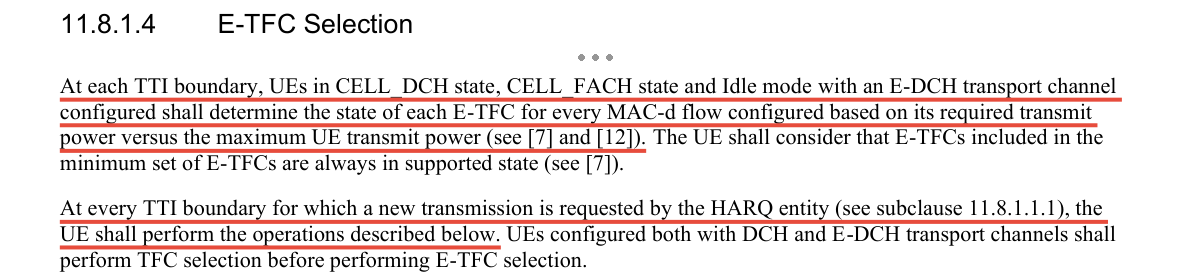
means for receiving at least one serving grant and at least one non-scheduled grant,
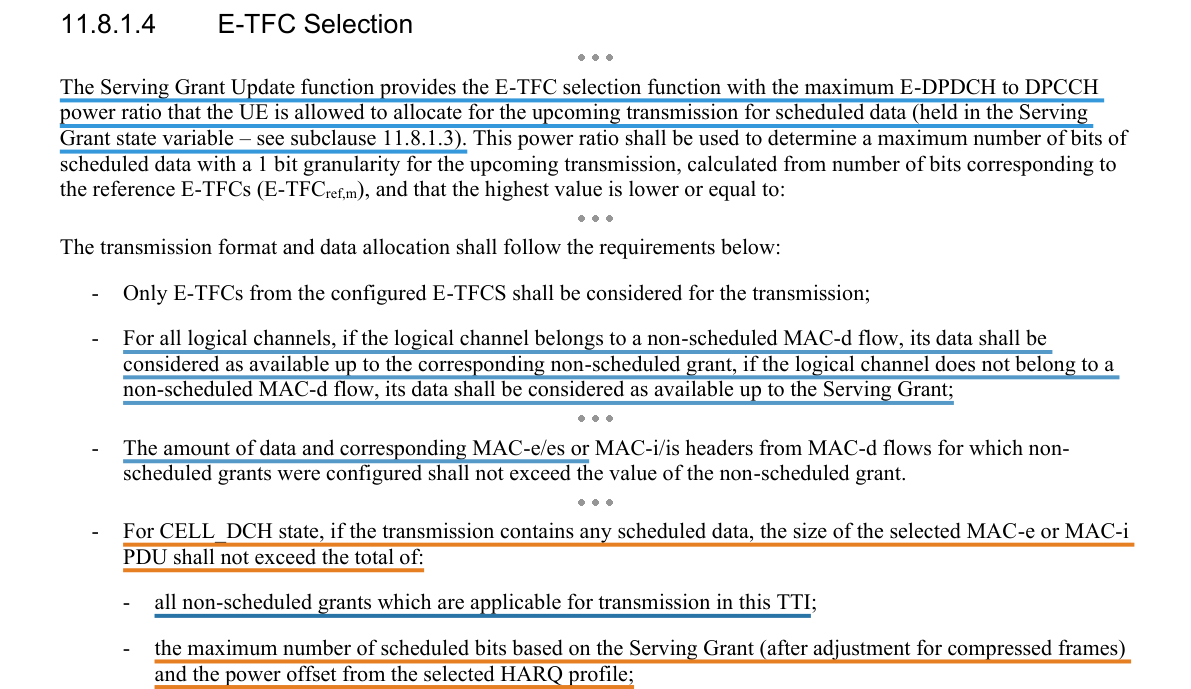
The UE maintains the Serving Grant state variable from the absolute and relative grant commands it decodes, and RRC allocates each non-scheduled grant to individual MAC-d flows; The serving grant is read on the state variable that the UE keeps from the received commands, and the non-scheduled grant on the grant given to a MAC-d flow when non-scheduled transmission is configured.
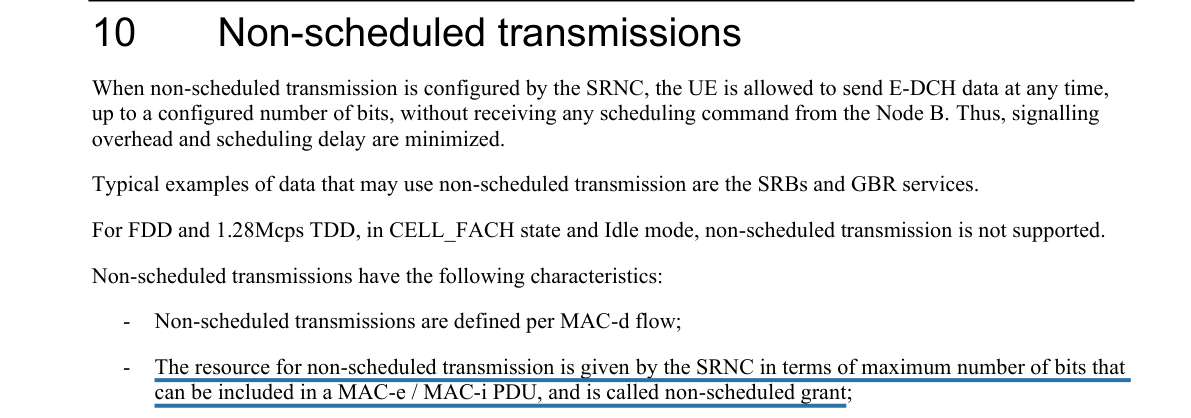


wherein the at least one serving grant is a grant for scheduled data transmission
The Serving Grant state variable indicates the maximum E-DPDCH to DPCCH power ratio that the UE is allowed to use for scheduled data in the following transmission, so the serving grant is the grant for scheduled data transmission.


and the at least one non-scheduled grant is a grant for non-scheduled data transmission, characterized by:
The resource given for non-scheduled transmission is called the non-scheduled grant; the UE may send E-DCH data up to it without receiving a scheduling command, and the data of a non-scheduled MAC-d flow is available up to the corresponding non-scheduled grant, so the non-scheduled grant is the grant for non-scheduled data transmission.
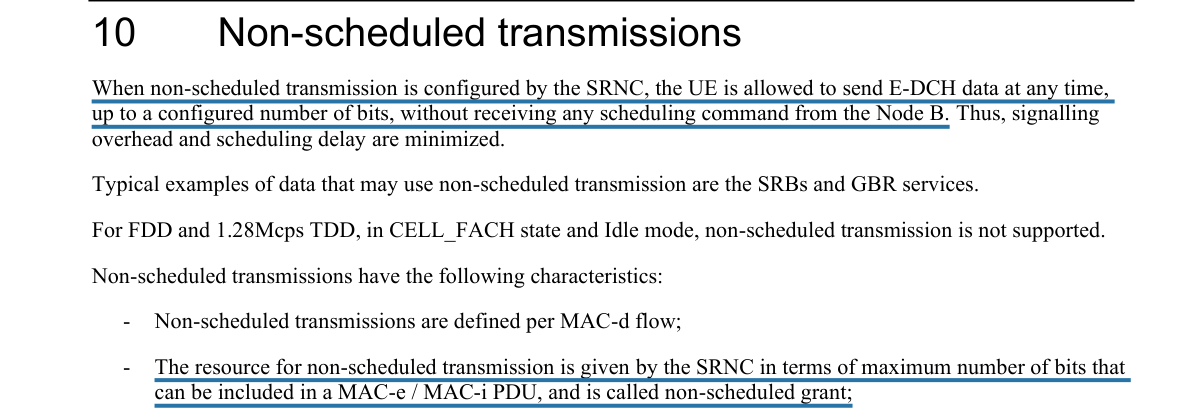
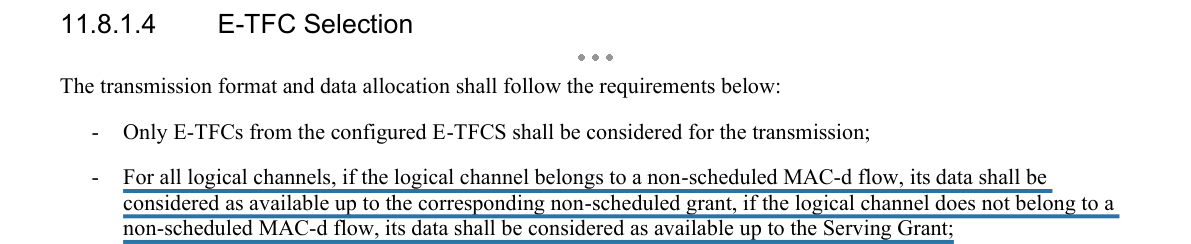
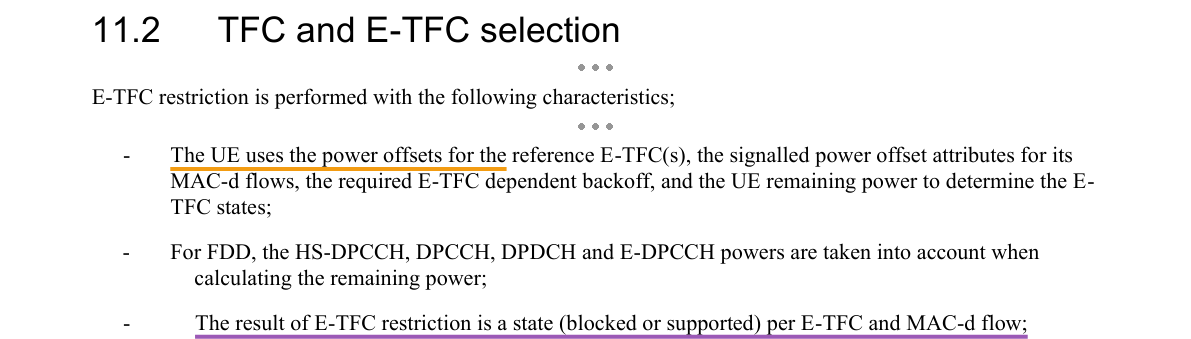
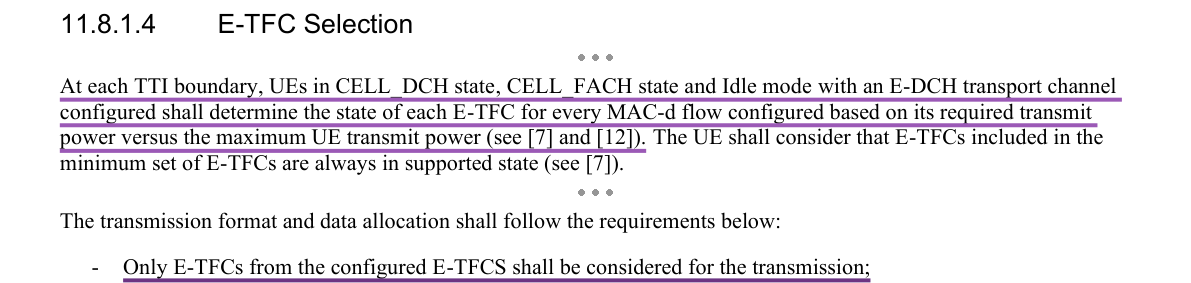
means for determining supported enhanced dedicated channel transport format combinations, E- TFCs, within a E- TFC set, E-TFCS, based on a remaining transmit power for enhanced uplink, EU, transmission
At each TTI boundary the UE determines the state of each E-TFC, supported or blocked, from its required transmit power versus the maximum UE transmit power; only E-TFCs from the configured E-TFCS are considered; the UE remaining power is estimated as the normalised remaining power margin available for E-TFC selection.

means for limiting medium access control for dedicated channel, MAC-d, flow data multiplexed into a medium access control for enhanced uplink, MAC-e, protocol data unit, PDU, to a largest E-TFC size that is smaller than a size of MAC-d flow data allowed by the received serving and non-scheduled grants and available for transmission.
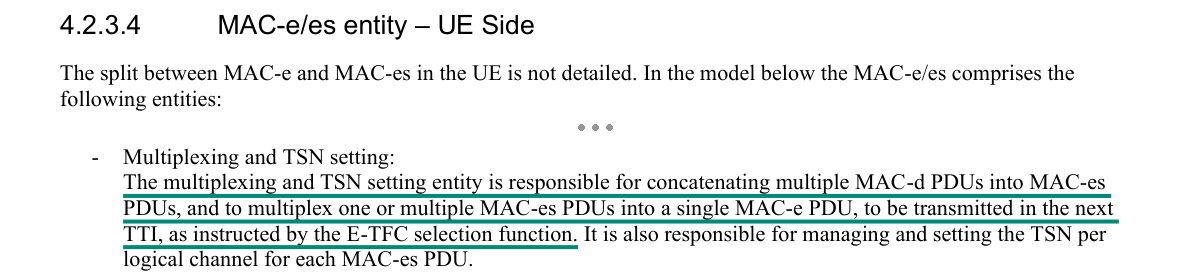
The data from MAC-d flows is available only up to the grants, and the amount from flows with non-scheduled grants may not exceed the value of the non-scheduled grant; it is multiplexed into a MAC-e PDU as instructed by E-TFC selection. The size of the selected MAC-e PDU shall not exceed the total of the applicable non-scheduled grants, the maximum number of scheduled bits based on the Serving Grant and the scheduling information, the received grants being the Serving Grant state variable provided by the Serving Grant Update function and all applicable non-scheduled grants. Among the supported E-TFCs the UE selects the smallest E-TFC that maximises the transmission of data according to the non-scheduled grant(s) or the serving grant; the claim's "largest … smaller than" is read as that maximum data fitting under the grants.


종합
L1–L5 map to the standard.
참고 문헌
- TS 25.321 — Medium Access Control (MAC) protocol specification
- TS 25.319 — Enhanced uplink; Overall description; Stage 2
- TS 25.133 — Requirements for support of radio resource management (FDD)
this document is a technical essentiality assessment prepared for reference, comparing published patent documents against 3GPP standard specifications. It is not a legal determination or legal advice on the essentiality, validity or infringement of the patent. Before any material decision such as licensing or litigation, obtain a review by a qualified patent attorney or attorney at law.
내 특허로 만들어 보기
특허 번호를 입력하면 같은 형식의 차트를 받습니다. 회사 이메일로 가입하면 첫 리포트 1건은 무료입니다.
시작하기